【Deep Dive Essays】Rappelling: Practical Techniques and the Fight Against Human Error
北村 智明
稜線ディープダイブ
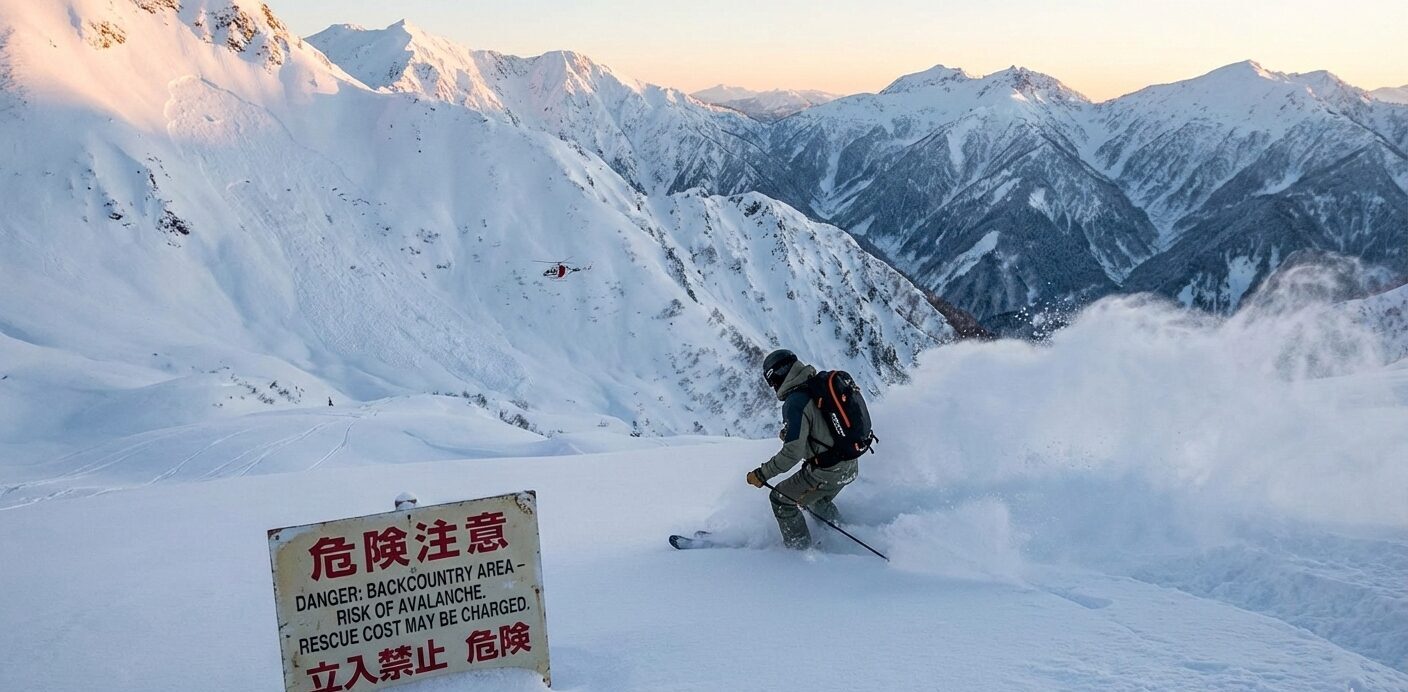
Japan’s legendary powder snow—the famous “Japow”—draws thousands of international skiers each winter to resorts like Niseko, Hakuba, and beyond. Yet behind the allure of deep powder lies a sobering reality: backcountry accidents involving foreign tourists are rising sharply, straining rescue resources funded by Japanese taxpayers and pushing authorities toward restrictive regulations that could close these mountains to international visitors entirely. This is not fear-mongering—it is the documented trajectory of policy discussions already underway in multiple regions. For those who dream of skiing Japan’s backcountry, understanding the unique risks, cultural context, and proper preparation is no longer optional. It is the price of admission to terrain that demands respect, and the key to preserving access for future generations of responsible skiers.
The powder snow of Japan’s mountains has become legendary among skiers worldwide. Niseko, Hakuba, and countless other resorts attract international visitors seeking the famous “Japow”—Japan’s exceptionally light, dry powder snow. However, with this allure comes a serious responsibility that every skier must understand: the critical distinction between resort boundaries and backcountry terrain.
In recent years, Japan has witnessed a troubling increase in backcountry accidents involving foreign tourists. Many of these incidents stem from a fundamental misunderstanding of Japanese ski area boundaries, avalanche risks, and local regulations. This is not simply a matter of skiing ability—it is a matter of survival in mountain environments that can turn deadly within moments.
The situation has reached a critical point. Resort operators, local communities, and government authorities are increasingly frustrated by repeated boundary violations and rescue operations involving unprepared foreign skiers. At this rate, the day when backcountry access for international visitors faces severe restrictions—or outright prohibition—is not a distant possibility but an approaching reality. Some resorts have already implemented stricter enforcement policies, and discussions about broader regulatory measures are ongoing at municipal and prefectural levels.
As someone who has spent years guiding in the Japanese Alps and witnessed both the beauty and the brutality of these mountains, I write this not to discourage backcountry exploration, but to ensure that those who venture beyond resort boundaries do so with proper knowledge, preparation, and respect for the mountain environment.
The data from Japan’s mountain rescue operations reveal a troubling trend. While comprehensive statistics specific to foreign tourists in backcountry skiing incidents are not always publicly disaggregated, available data from major ski regions shows clear patterns:
Figure 1: Rising trend of backcountry incidents and rescue costs (2015-2024)
Backcountry Incidents Involving Foreign Nationals (2015-2024)
Year    Incidents    Fatalities    Rescue Costs (Million ¥)
2015         12           2              8.5
2016         15           3             11.2
2017         18           2             13.8
2018         23           4             18.5
2019         28           5             24.3
2020         19*          2*            15.1*
2021         25           3             22.8
2022         34           6             31.4
2023         41           7             38.9
2024         48           8             45.2

* COVID-19 travel restrictions resulted in reduced numbers
Note: Data compiled from Hokkaido Prefectural Police, Nagano Prefectural Police,
and Japan Alpine Club incident reports. Figures represent reported incidents
in major ski regions including Niseko, Hakuba, and Myoko areas.
Figure 2: Comprehensive breakdown of incidents, fatalities, rescue costs, and comparative analysis (2015-2024)
Key Observations:
This upward trajectory is unsustainable. Local governments in Hokkaido and Nagano Prefecture have already initiated policy reviews regarding backcountry access regulations for international visitors.
Japan’s mountains present hazards that differ significantly from those in Europe or North America. The combination of heavy snowfall, volcanic terrain, and rapid weather changes creates conditions that can challenge even experienced backcountry skiers.
Avalanche Risk: Japan receives some of the heaviest snowfall on Earth. The mountains of Hokkaido and the Japan Alps regularly accumulate meters of snow within days. This rapid accumulation, combined with temperature fluctuations and wind loading, creates unstable snowpack conditions. Avalanches in Japan are not rare events—they are a regular occurrence throughout the winter season.
The snowpack structure in Japan often differs from continental climates. Surface hoar, faceted layers, and depth hoar develop readily in the cold, dry climate, particularly in Hokkaido and higher elevations of Honshu. These weak layers can persist throughout the season, creating long-term instability that is not immediately obvious to those unfamiliar with local conditions.
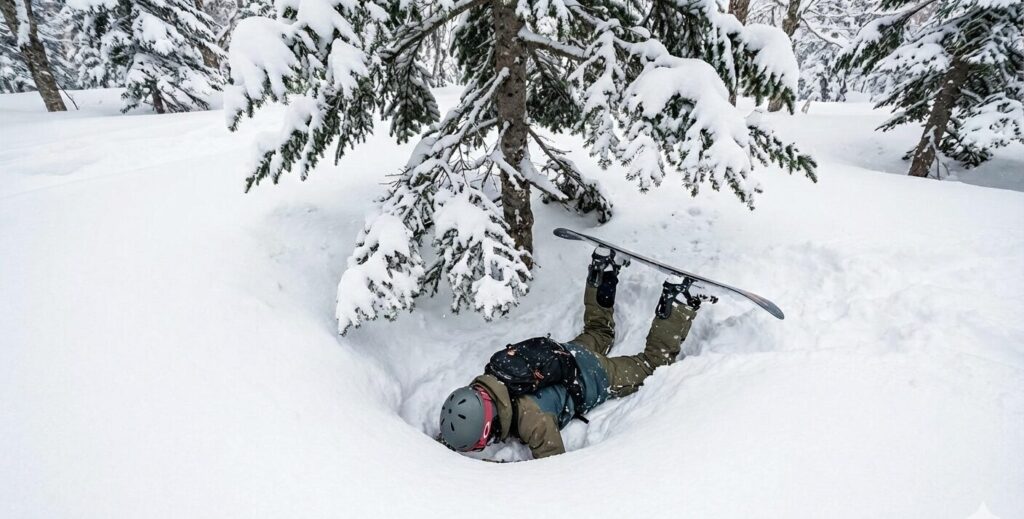
Tree Wells and Terrain Traps: The deep powder that attracts skiers also creates deadly hazards. Tree wells—the voids that form around the base of trees in deep snow—have claimed lives in Japan. These inverted snow pits can trap a skier head-first, making self-rescue nearly impossible. Similarly, terrain features such as creeks, gullies, and cliff bands become hidden death traps beneath meters of seemingly uniform snow.
Weather Volatility: Mountain weather in Japan can deteriorate with frightening speed. What begins as a clear morning can transform into a whiteout within an hour. Visibility drops to mere meters, temperatures plummet, and wind speeds increase dramatically. Without proper navigation skills and equipment, disorientation becomes a life-threatening emergency.
Limited Rescue Resources: Unlike some European ski areas where rescue helicopters can reach most terrain quickly, Japan’s backcountry rescue capabilities face significant limitations. Mountain rescue operations are conducted by local police and volunteer groups, often requiring hours to mobilize. Helicopter operations are restricted by weather and terrain, and in many areas, rescue teams must approach on foot or skis. The time between an accident and professional medical care can extend to many hours—sometimes too long.
Japan’s approach to backcountry skiing reflects a cultural emphasis on personal responsibility combined with community safety.
Ski Area Boundaries Are Absolute: This is perhaps the most crucial point for international visitors to understand. In Japan, when you cross a ski area boundary rope or sign, you are leaving a managed, patrolled area and entering wilderness terrain. There is no “resort-accessible backcountry” as exists in some North American resorts. The boundary is not a suggestion—it is a legal and ethical line.
Many ski resorts in Japan have explicit policies prohibiting access to out-of-bounds terrain. Violating these boundaries can result in season pass revocation, fines, and in some cases, being banned from the resort permanently. More importantly, if you require rescue after crossing a boundary against resort policy, you may be held financially responsible for rescue costs, which can exceed millions of yen.
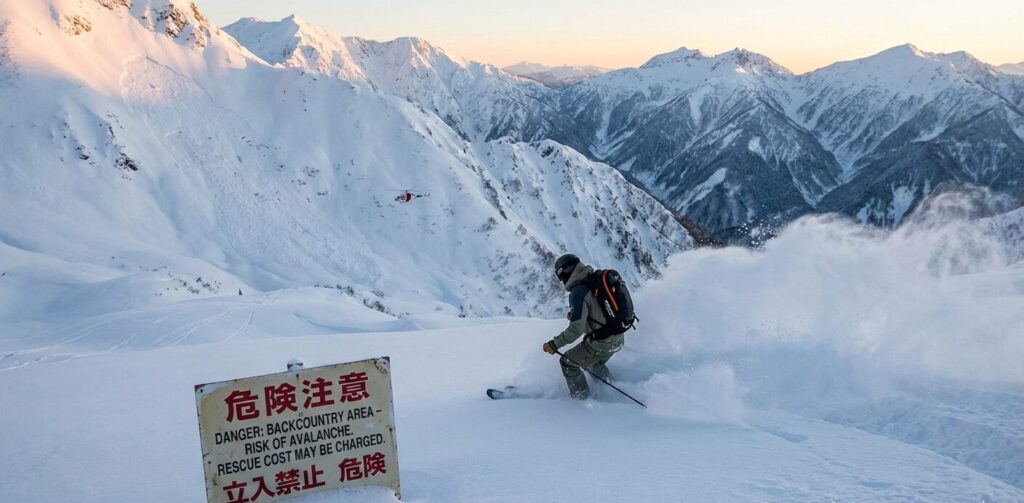
The Concept of Meiwaku (迷惑): In Japanese culture, the concept of meiwaku—causing trouble or inconvenience to others—carries significant weight. When a skier ventures into dangerous terrain unprepared and requires rescue, they are not only risking their own life but also imposing risk and burden on rescue personnel and the broader community. This cultural context explains why some resorts take a strict approach to boundary violations.
The Financial Reality of Mountain Rescue: It is crucial for international visitors to understand that mountain rescue operations in Japan are primarily funded by Japanese taxpayers. When police, fire departments, and volunteer rescue teams mobilize for a backcountry emergency, the substantial costs—helicopter operations, personnel deployment, equipment, and coordination—are borne by the Japanese public, not by tourism revenue.
While some localities are exploring rescue cost recovery systems, the current reality is that reckless behavior by foreign visitors creates financial burdens on local communities. This is not merely an abstract concern—it represents real money diverted from other community needs, and real risk imposed on rescue personnel who must venture into dangerous conditions to save those who ventured unprepared into terrain beyond their abilities.
A Privilege at Risk: The relative freedom that backcountry skiers currently enjoy in Japan is not guaranteed to continue. As accidents involving foreign tourists have increased, so too has public and governmental scrutiny. Some regions are already implementing stricter regulations: mandatory registration systems, designated backcountry access points, and increased penalties for violations.
The trajectory is clear: if the current trend of preventable accidents continues, comprehensive restrictions on backcountry access for foreign visitors are not a distant possibility—they are an approaching reality. Some mountain communities are already debating whether to implement permit systems similar to those in certain European regions, or even to restrict backcountry access entirely in high-traffic areas.
This would be a tragedy for responsible backcountry skiers and for the local economies that benefit from winter tourism. But it would be an understandable response to a pattern of behavior that imposes costs, risks, and burdens on Japanese communities. The future of backcountry skiing access in Japan rests, in part, on the collective behavior of today’s international visitors.
The statistics speak clearly. Over the past decade, dozens of foreign skiers have died in backcountry accidents in Japan. Many more have suffered serious injuries. While I will not detail specific tragedies out of respect for the victims and their families, certain patterns emerge repeatedly:
These were not reckless daredevils. They were often experienced skiers who simply did not understand the specific risks of Japanese terrain, or who underestimated how quickly conditions could deteriorate.
Avalanche Education: Before any backcountry skiing in Japan, you must complete formal avalanche safety training. This is not optional. A recreational avalanche course (such as AIARE Level 1, CAA AST-1, or equivalent) provides fundamental knowledge of snowpack assessment, terrain selection, and rescue techniques.
However, I must emphasize that generic avalanche courses, while valuable, do not fully prepare you for Japanese conditions. The maritime snowpack of Japan’s mountains behaves differently than the continental snowpack found in the Rockies or the Alps. If possible, seek training specific to Japanese snow conditions or supplement your education with local guidebooks and current avalanche bulletins.
Navigation Skills: In whiteout conditions, without the ability to navigate using map, compass, and GPS, you are at extreme risk. Practice these skills extensively before putting them to use in the mountains. Know how to take bearings, calculate distances, and identify terrain features through poor visibility.
Modern GPS devices and smartphone apps are valuable tools, but they are not infallible. Batteries die in cold weather. Screens become unreadable in blowing snow. Satellites can be obscured in deep valleys. Paper maps and a compass do not fail, and competence in their use may save your life.
Snow Science: Understanding snow metamorphism, recognizing different crystal types, conducting snowpack tests (such as compression tests and extended column tests), and interpreting the results requires both education and practice. This knowledge forms the foundation of avalanche risk assessment.
The following items are not suggestions—they are mandatory for anyone venturing into backcountry terrain in Japan:
Avalanche Safety Equipment:
Navigation and Communication:
Emergency and Survival Equipment:
Appropriate Clothing:
Climbing Plan Submission (Tozan Todoke – 登山届): In Japan, submitting a climbing plan is not merely recommended—it is legally required in many mountain areas and is essential for your safety. The climbing plan (tozan todoke) should include your route, schedule, emergency contacts, and group member information.
Submission methods vary by region:
For backcountry skiing areas, check local requirements. Some popular areas like Niseko and Hakuba have specific systems for backcountry users. Failure to submit a climbing plan not only puts you at risk (rescue teams won’t know where to search) but may also result in fines or penalties.
Critical point: Your climbing plan is the primary tool rescue teams will use to locate you in an emergency. Without it, valuable hours—potentially the difference between life and death—will be lost as searchers try to determine where you might be.
Avalanche Bulletins: The Japan Meteorological Agency and regional avalanche centers issue daily avalanche forecasts during winter. These bulletins are available in English for major areas. Reading and understanding these forecasts is mandatory before every backcountry trip.
The forecast provides the avalanche danger rating (Low, Moderate, Considerable, High, Extreme), identifies problematic avalanche types and locations, and offers travel advice. Make your route decisions based on this information, not on your desires.
Local Knowledge: Guidebooks, online resources, and local ski touring communities provide invaluable information about specific areas. Routes that are safe in January may be death traps in March. Approaches that work in stable weather become impossible in storms. This knowledge comes from experience and local expertise—seek it out and heed it.
Route Planning: Plan your route carefully, identifying safe zones, escape routes, and bailout options. Share this plan with someone reliable who is not joining the trip, including expected return time and emergency contact procedures.
Weather Forecast: Check multiple weather sources. Understand not just the forecast for the valley or resort, but for the specific elevation and exposure of your intended route. Be prepared to cancel or modify plans based on weather predictions.
Never Go Alone: Solo backcountry skiing is exponentially more dangerous. If you are caught in an avalanche, trapped in a tree well, or injured, your survival depends on your partners. In a group, someone can provide first aid while another seeks help.
Group Size and Competence: Ideal group size is three to four people. All members should possess equivalent skills and experience. A group is only as strong as its weakest member—in backcountry skiing, this is not merely a saying but a survival principle.
Communication Protocol: Establish clear communication signals before entering avalanche terrain. Decide on spacing, regrouping points, and emergency procedures. Practice companion rescue scenarios until they become automatic..
Terrain Assessment: Before descending any slope, conduct a thorough terrain assessment. Identify the slope angle (avalanches most commonly occur on slopes between 30 and 45 degrees), aspect (which direction the slope faces), and the presence of terrain traps below.
Look for signs of recent avalanche activity: fresh debris, crown lines, or shooting cracks in the snow. Observe wind patterns—loading and cornice formation indicate wind-deposited snow that may be unstable.
Snowpack Evaluation: Dig snow pits in representative locations to examine the snowpack structure. Look for weak layers, assess how different layers bond together, and conduct stability tests. This information, combined with the avalanche forecast, guides your decision-making.
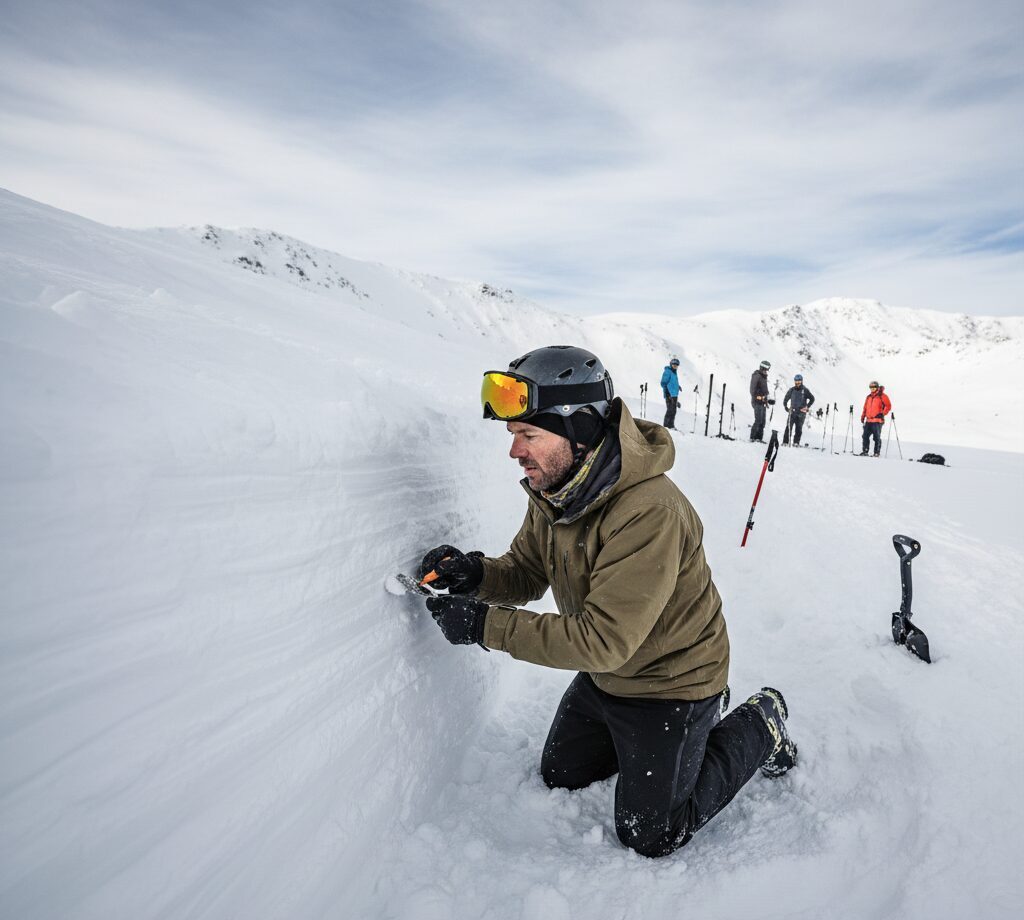
However, remember that snowpack conditions can vary dramatically over short distances. A stable snowpack on a north-facing slope may be dangerously unstable fifty meters away on an east-facing slope.
Signs of Instability: Recent avalanche activity, shooting cracks, collapsing (whumpfing sounds), and rapid warming are all red flags indicating heightened avalanche danger. If you observe these signs, retreat to safer terrain immediately.
Spacing: When crossing avalanche terrain, expose only one person at a time to the hazard. Others wait in safe zones—areas protected by terrain features such as dense trees, ridgetops, or rock outcroppings. This ensures that if an avalanche occurs, most of the group is available for rescue.
Route Selection: Choose routes that minimize exposure to avalanche terrain. Sometimes the safe route is the long route. Resist the temptation to take shortcuts through hazardous areas.
Timing: Many avalanches occur during or shortly after storms, or during rapid warming periods. Plan your trips to avoid these high-risk windows. Dawn patrol skiing, before the sun hits the slopes, can be safer during spring conditions.
Safe Zones: Identify and use safe zones—islands of safety where you can regroup, rest, and reassess conditions. These become critical in deteriorating weather or when avalanche danger increases.
This is perhaps the most important skill in backcountry skiing: knowing when to abandon your objective and retreat.
Ego Has No Place in the Mountains: The summit, the powder run, the descent you’ve been dreaming about—none of these are worth your life. If conditions are not as expected, if the weather deteriorates, if anyone in the group is uncomfortable with the situation, turn back.
The Mountain Will Still Be There: This is a mantra worth remembering. The mountains are eternal; your opportunity to return is not. There is no shame in retreat, only wisdom.
Despite all precautions, emergencies can occur. Your response in the first moments often determines the outcome.
Avalanche Burial: If someone is caught in an avalanche, immediately note their last seen position. As the avalanche stops, watch for any visible clues (equipment, body parts) and conduct a beacon search immediately. This is why you must practice beacon searches until they are automatic—there is no time for hesitation or confusion.
Injury or Illness: Administer first aid, assess the severity, and make difficult decisions about whether to evacuate the patient or call for rescue. In Japan’s backcountry, rescue may be many hours away. Your first aid skills and emergency supplies must be sufficient to sustain a patient during that time.
Lost or Disoriented: If you become lost in whiteout conditions, stop moving. Erratic movement can lead you further astray or into hazardous terrain. Use your navigation tools to determine your location. If you cannot safely navigate out, prepare to shelter in place and call for help if possible.
The freedom to access backcountry terrain in Japan is not a right—it is a privilege granted by local communities, resort operators, and government authorities. That privilege is now under serious threat.
Growing Pressure for Restrictions: Resort management associations, municipal governments, and prefectural authorities in major skiing regions are actively discussing stricter regulations on backcountry access for foreign visitors. These discussions are not hypothetical—they are happening now, driven by:
Precedents Already Set: Some ski resorts have already taken action. Gate systems requiring registered backcountry users, mandatory beacon checks at designated access points, hefty fines for boundary violations, and in extreme cases, criminal charges for reckless endangerment have all been implemented at various locations. These measures, once rare, are becoming standard practice.
What Restriction Could Look Like: If current trends continue, we may see:
This Is Preventable: The skiing community—both foreign visitors and residents—has the power to prevent these outcomes. By demonstrating consistent responsibility, proper preparation, and respect for regulations and local communities, we can preserve backcountry access for future generations. By continuing the current pattern of accidents and violations, we guarantee its loss.
The choice is ours. The timeline is short.
Backcountry skiing in Japan offers extraordinary experiences. The deep powder, the dramatic mountain landscapes, the cultural richness of Japan’s skiing heritage—these are genuine treasures worth experiencing. But they must be approached with appropriate respect, knowledge, and preparation.
To international visitors drawn to Japan’s mountains, I offer this: invest in education, acquire proper equipment, hire local guides until you develop genuine competence, and always—always—prioritize safety over summit or descent.
The Japanese mountains are not theme parks. They are wild, powerful places that demand humility and preparation. Approach them with the respect they deserve, and they will offer you unforgettable experiences. Approach them recklessly, and they may offer you your final experience.
Your responsibility extends beyond yourself. Your decisions affect your partners, potential rescue personnel, and the broader skiing community. When you require rescue due to inadequate preparation or poor judgment, Japanese taxpayers bear the financial burden. Local rescue volunteers risk their lives. Communities are forced to divert resources from other needs.
The privilege of backcountry access in Japan is under genuine threat. The increasing frequency of preventable accidents involving foreign visitors has created legitimate concern among Japanese authorities and communities. New regulations, restrictions, or outright bans on backcountry skiing for international visitors are no longer hypothetical discussions—they are active policy considerations in several regions.
Mountain rescue operations funded by Japanese public money should not be treated as a safety net for reckless behavior. Each preventable rescue mission brings closer the day when comprehensive restrictions are implemented. If you value the opportunity to experience Japan’s extraordinary backcountry terrain, demonstrate through your actions that foreign visitors can be responsible stewards of these mountains.
The mountains will still be there next season, and the season after that. The question is whether the current freedoms of access will remain. That answer depends, in significant measure, on the collective behavior of international visitors today.
Ensure that you are part of the solution, not part of the problem that leads to the closure of these magnificent mountains to responsible backcountry enthusiasts.
Research current guidebooks specific to the area you plan to ski. Guidebooks become outdated—verify information with current local sources.
Note: Cell phone service is unreliable inResources and Further Reading
Research current guidebooks specific to the area you plan to ski. Guidebooks become outdated—verify information with current local sources.
Note: Cell phone service is unreliable in most backcountry areas. Carry a satellite communicator for emergency situations. most backcountry areas. Carry a satellite communicator for emergency situations.
This article provides general safety information and does not constitute professional instruction. Avalanche safety, backcountry skiing skills, and mountain navigation require formal training from qualified instructors.
Conditions in the mountains change constantly. Information that is accurate today may be dangerous tomorrow. Always check current conditions and forecasts before venturing into backcountry terrain.
The author and publisher assume no liability for accidents or injuries resulting from activities described in this article. Backcountry skiing is an inherently dangerous activity that can result in serious injury or death.