【Deep Dive Chronicle】Naranokisawa-Kamosawa Stream Climbing: Three Nights of Unexpected Wandering in the Iide Mountains
北村 智明
稜線ディープダイブ

On the first day of the three-day weekend that includes Coming of Age Day, we headed for Mt. Yudono-san, one of the sacred peaks of Dewa Sanzan. Our backcountry ski tour (Yama-suki) from Shizu Onsen was shaped by an unexpected binding failure and by a powder-snow descent through the beech forest of the Southeast Ridge. This is an account of a winter day spent with eleven companions.
It was the first day of the three-day weekend that includes Coming of Age Day (Seijin no Hi, a national holiday in January celebrating those who have turned twenty), in the eighth year of Reiwa (2026). The forecast called for the weather to break from the next day, and many backcountry skiers had gathered around Shizu Onsen. We were one of those groups.
We left Miyagi early in the morning, still in darkness. In the car, the members ran their final gear checks: binding tension, beacon (avalanche transceiver) batteries, spare wakan (Japanese ring snowshoes). With twelve of us, it was a big party. Checking each item one by one is a kind of ritual, and it underpins the safety of a tour.
Recent winters have trended warm, and this one was no exception. I had seen reports that Yamagata Prefecture was getting less snow than usual. Yet as we approached Shizu Onsen, the snow walls beside the road grew taller. It was a glimpse of the real strength of heavy-snow country.
The road to Shizu Onsen, at the foot of Mt. Gassan, had been well plowed, and we were able to drive up to the end of the plowed section. Just after 8:00 AM the sky was clear and bright. It was warm for the season, a mild morning.
Stepping out of the car, we checked our gear once more. The twelve members varied in skill. U was on only their second backcountry ski tour, and one member had joined us on a snowboard. The remaining ten were experienced, but we still had to look after the group as a whole, which called for careful route selection.
I ran a beacon check for everyone, confirming transmit and receive one person at a time. Battery levels were fine. The risk of avalanche is always present, and a beacon is equipment that ties a life to the surface. There is no room for compromise in checking it. Finishing all twelve took about ten minutes.
Preparations complete, we set out. A large party has its difficulties, but it is also reassuring. If something happens, there are companions to help one another. In the mountains, that is a great asset.
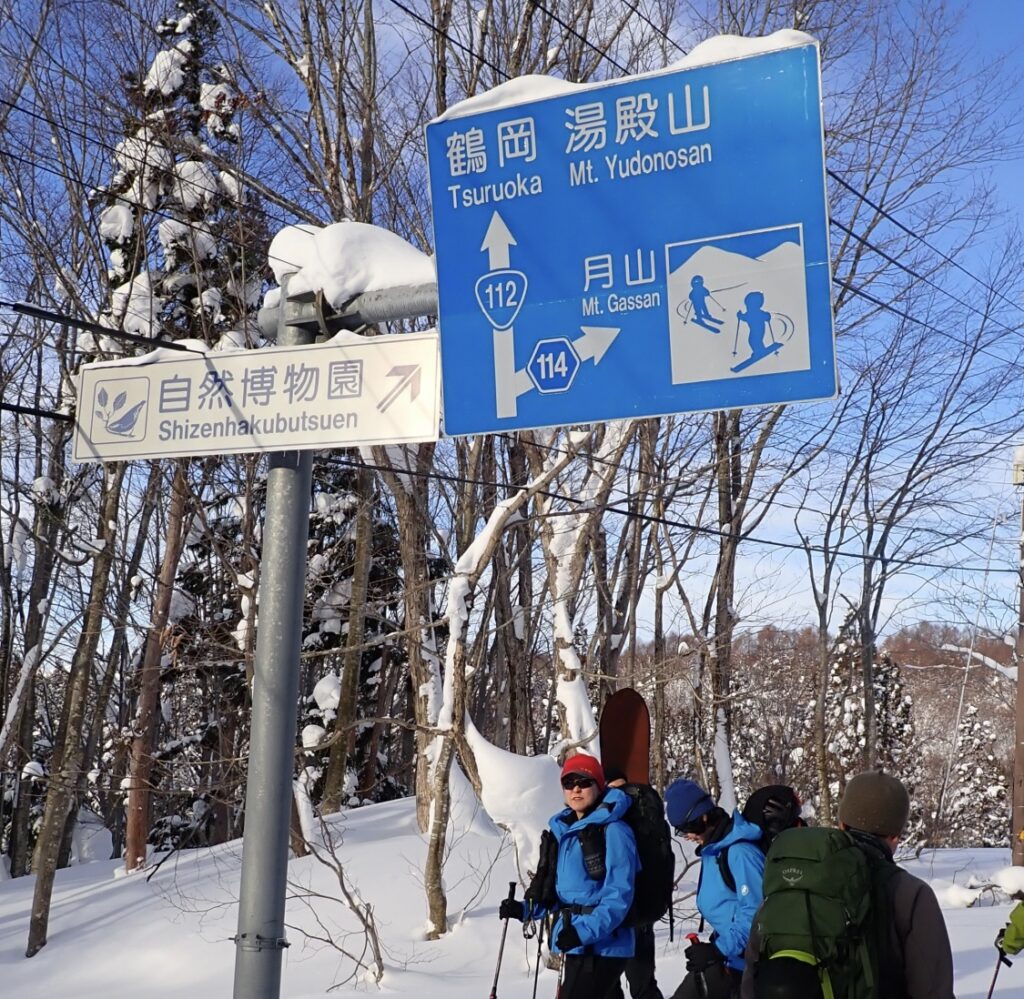
We passed the bus stop in front of the Shizu Campground. A blue road sign reading “Tsuruoka / Yudono-san” appeared ahead, still hanging high above our heads. By February the snow will have piled up to within arm’s reach of it, but in mid-January it hadn’t gotten there yet. Even in a warm winter, this is heavy-snow country, and the depth of the snowpack speaks to how severe winter is here.
We followed the forestry road toward the Nature Center. The forest of giant beeches was wrapped in deep stillness. Snow on the branches glittered in the morning sun. The rime ice flashed as sharply as polished silver, and looked delicate enough to shatter at a touch.
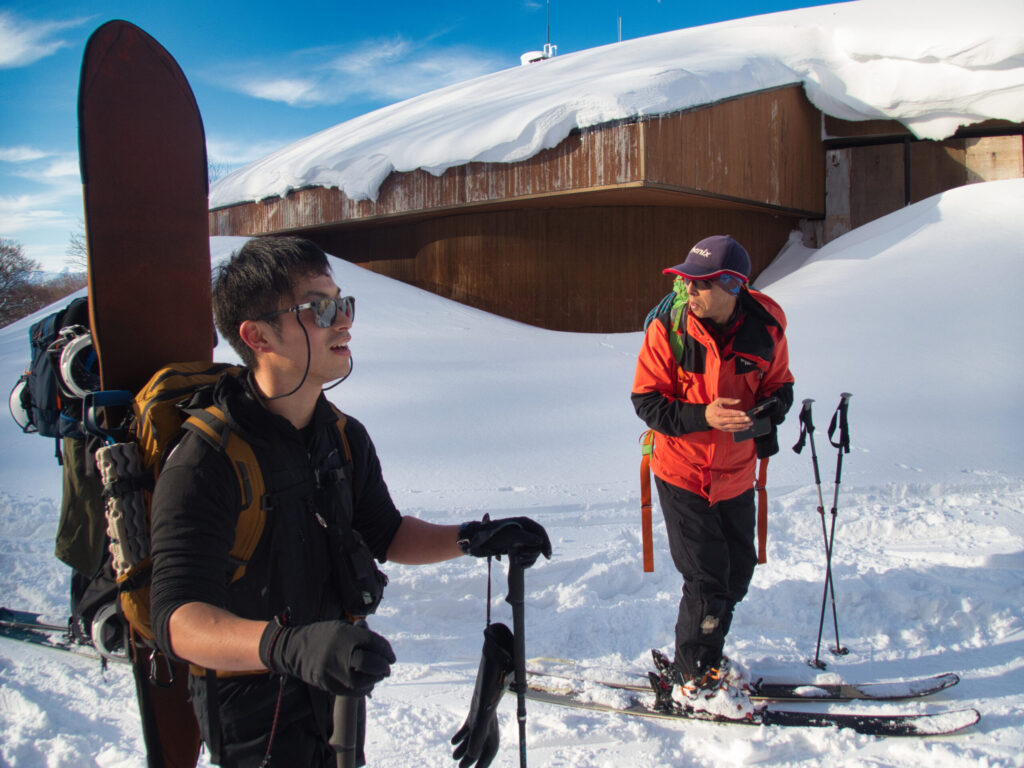
After a short break at the Nature Center, the real climb began. Our skis, fitted with climbing skins (adhesive strips on the base that grip the snow for uphill travel), bit into the fresh snow and carried us upward. Snow quality was excellent. The feel of the powder raised our anticipation for the descent to come.
But then things took an unexpected turn.
Soon after we started up, I heard S cry out. I turned to see her lying in the snow. When I ran over, I found that her binding had come completely off its mount. The gear was brand new. Can this really happen? I thought.
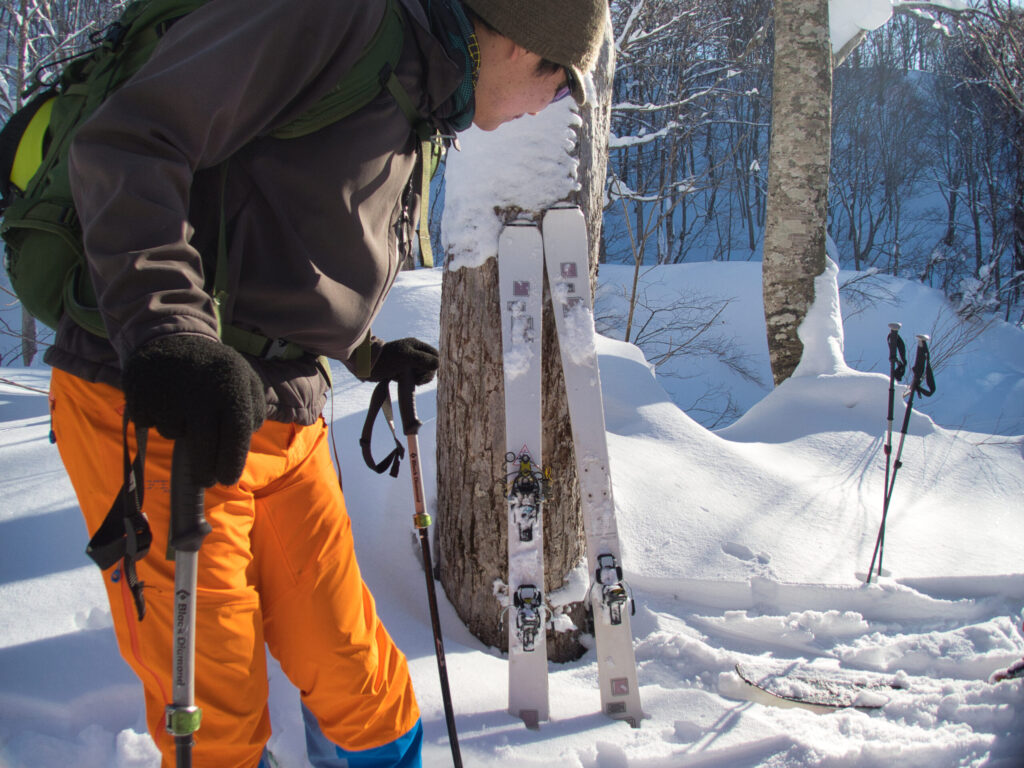
S tried to reattach it several times, but the binding never locked onto the ski again. We conferred.
Should we turn back here? The weather was stable, and the route was not dangerous. But one member being unable to use her skis was a risk factor. It would take time and add physical strain. Even so, S wanted to continue. “I’ll climb in wakan,” she said.
If safety came first, retreating was an option. But if we trusted S’s strength and resolve, continuing was possible. The weather was good, and with twelve members we had enough people to deal with problems.
We cached her skis, and with S now fitted with wakan, we resumed the climb: eleven on skis, one on snowshoes. It was an odd formation, but no reason to abandon the tour.
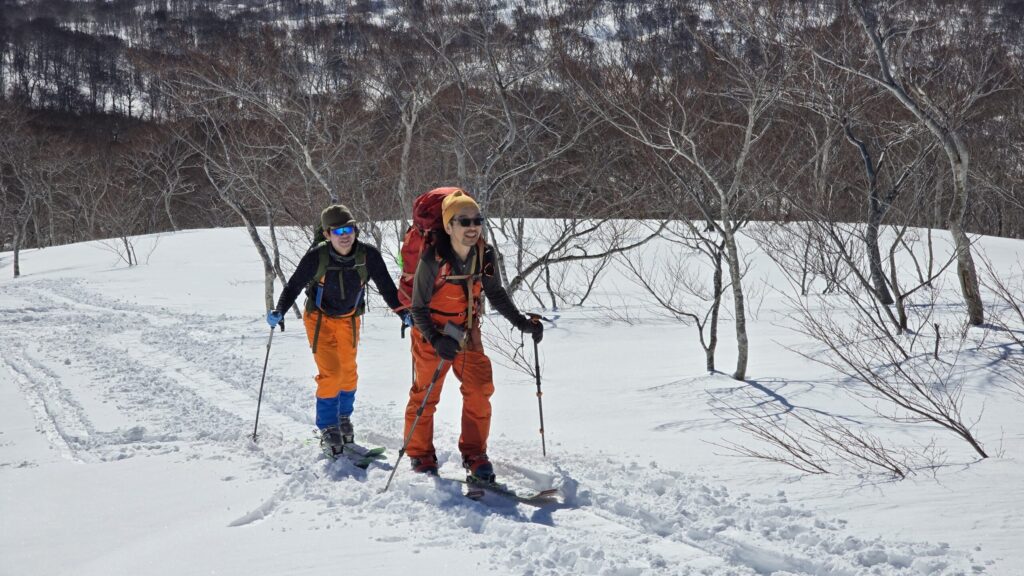
As we gained elevation, the heat began to tell on us. I took off a layer, and so did the others. It is rare to feel this hot on a winter ski tour. The effects of the warm winter had reached even this remote mountain.
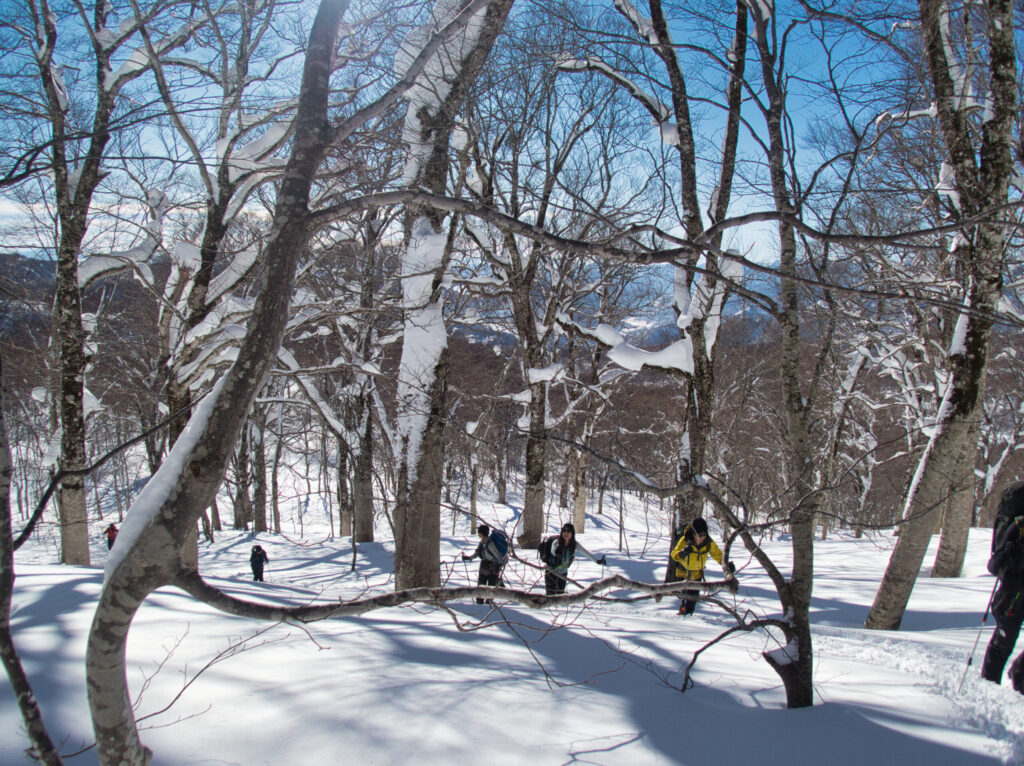
The beauty of the beech forest did not change as we climbed: snow clinging to the trunks, rime-covered twig tips, blue sky showing between the trees. This scenery alone made the climb worthwhile.
S’s pace in wakan was faster than I had expected, and her strong legs helped us. We stopped from time to time to wait for her, and once everyone had caught up, we resumed the climb. The rhythm was good.
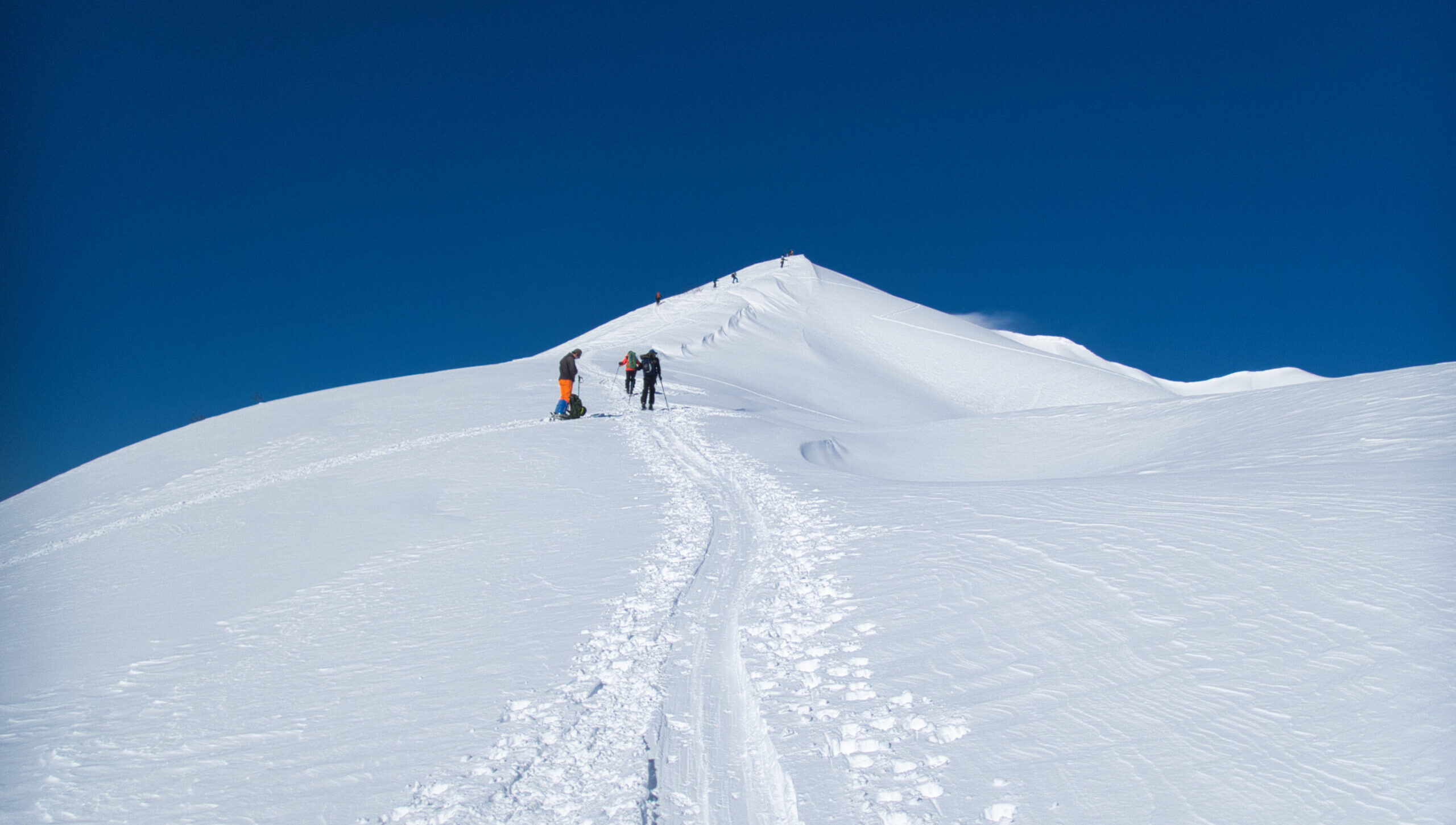
At 11:30 AM, we reached the summit of Mt. Yudono-san.
Mt. Yudono-san stands 1,500 meters above sea level and has long drawn worshippers as one of the Dewa Sanzan (the Three Sacred Mountains of Dewa). Together with Mt. Haguro-san and Mt. Gassan, it forms the Dewa Sanzan, and it is known as a mysterious sacred site of which tradition says: “Do not speak of it, do not listen.” It is also a holy ground of Shugendō (Japan’s mountain asceticism tradition), where ascetics once trained to become sokushinbutsu (self-mummified monks). In summer many pilgrims visit, but the winter summit was a harsh world far removed from faith.
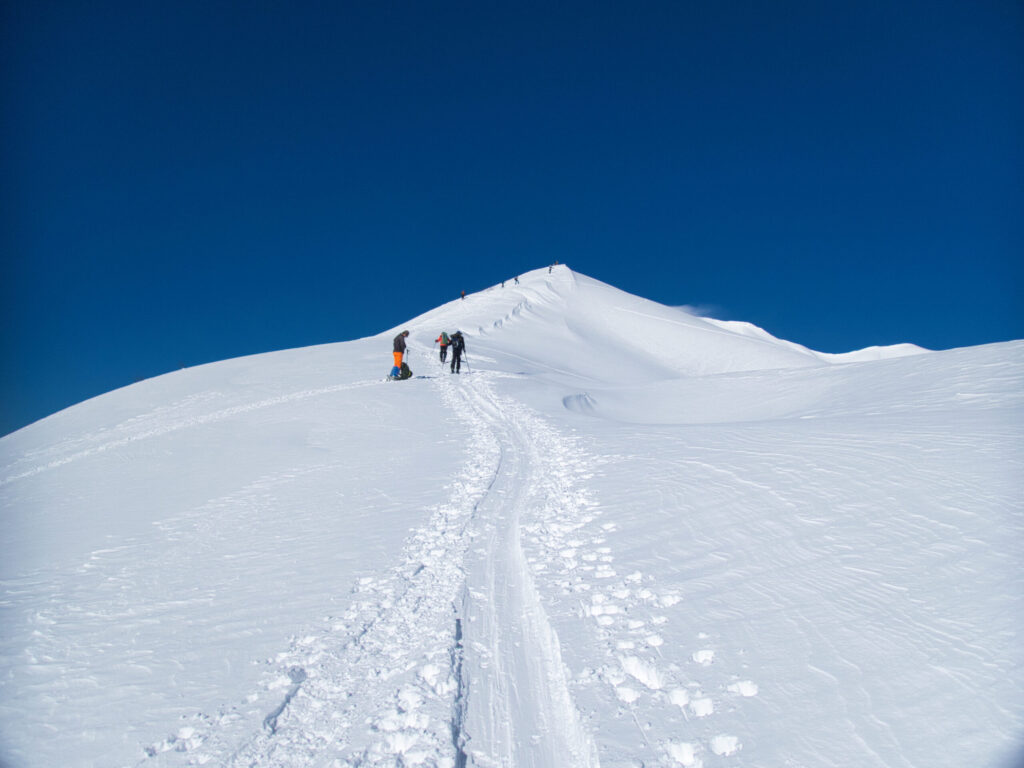
Only the summit was exposed to strong wind. The calm weather we had enjoyed on the climb changed completely here. The wind whipped up spindrift and stole our visibility. A white haze wrapped the summit and blurred our figures. It was hard even to stand without crouching low.
Below us lay Mt. Gassan, and in the distance we could make out the form of Mt. Chokai. The view from the clear summit was magnificent, but the strength of the wind and spindrift left no room to enjoy it at leisure.
Here we confirmed our descent route.
The plan we had decided beforehand was to descend the Southeast Ridge. We would pass the entrance to Ishippane-zawa but not enter the stream valley, following the ridgeline instead. Considering the skill level of the group as a whole, the ridge route was the best choice. S would have to walk down in wakan. We had to choose a route on which everyone could descend safely.
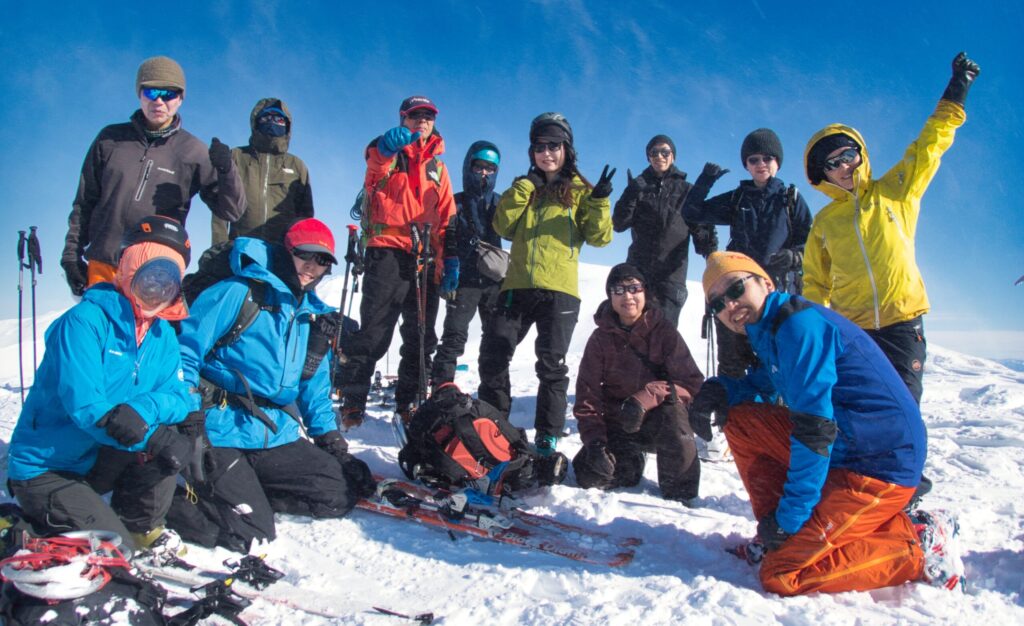
Our stay on the windswept summit was short. After about 24 minutes, we began the descent.
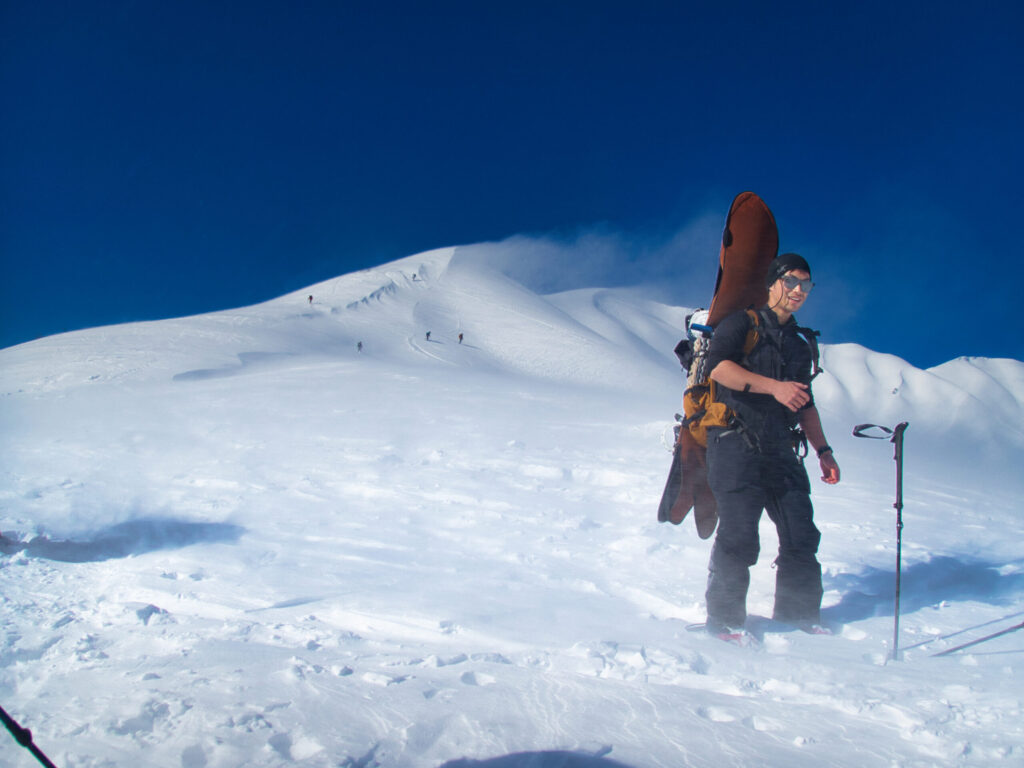
We descended the Southeast Ridge carefully, S on wakan and the rest of us on skis. The snowboarder was coming down without any trouble as well. Snow quality remained excellent, and the powder cradled our skis softly.
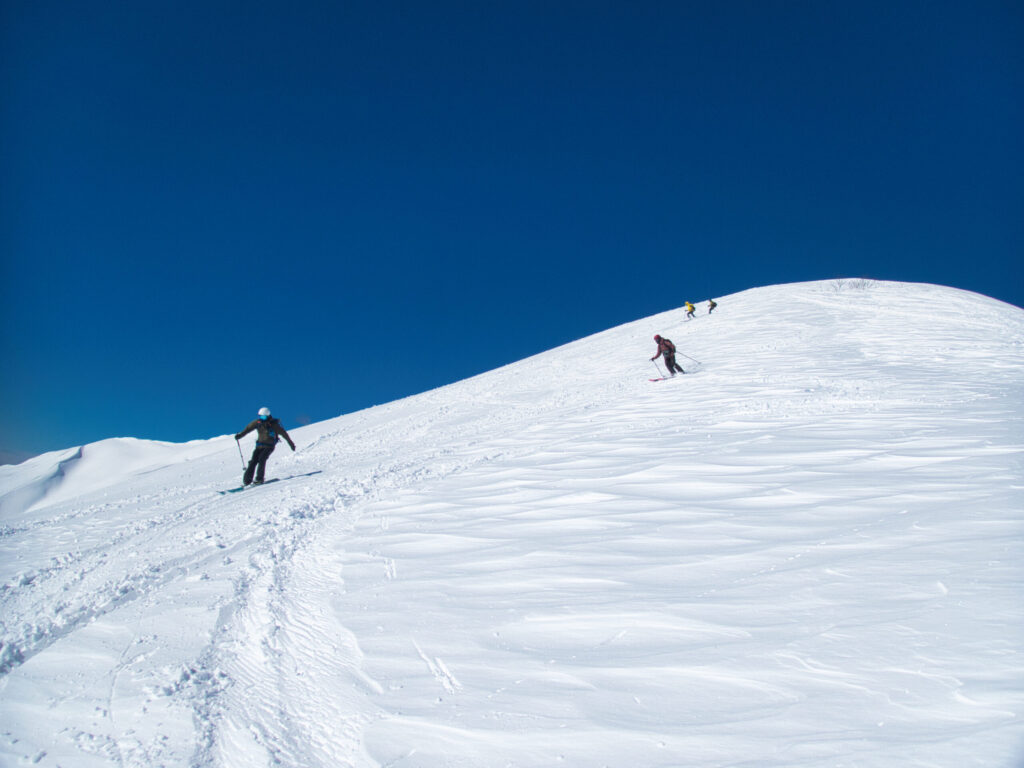
Before long we entered the forest along the ridge. The slope of giant beeches had a moderate pitch, ideal for skiing.
The descent through the ridge forest became the highlight of the day.
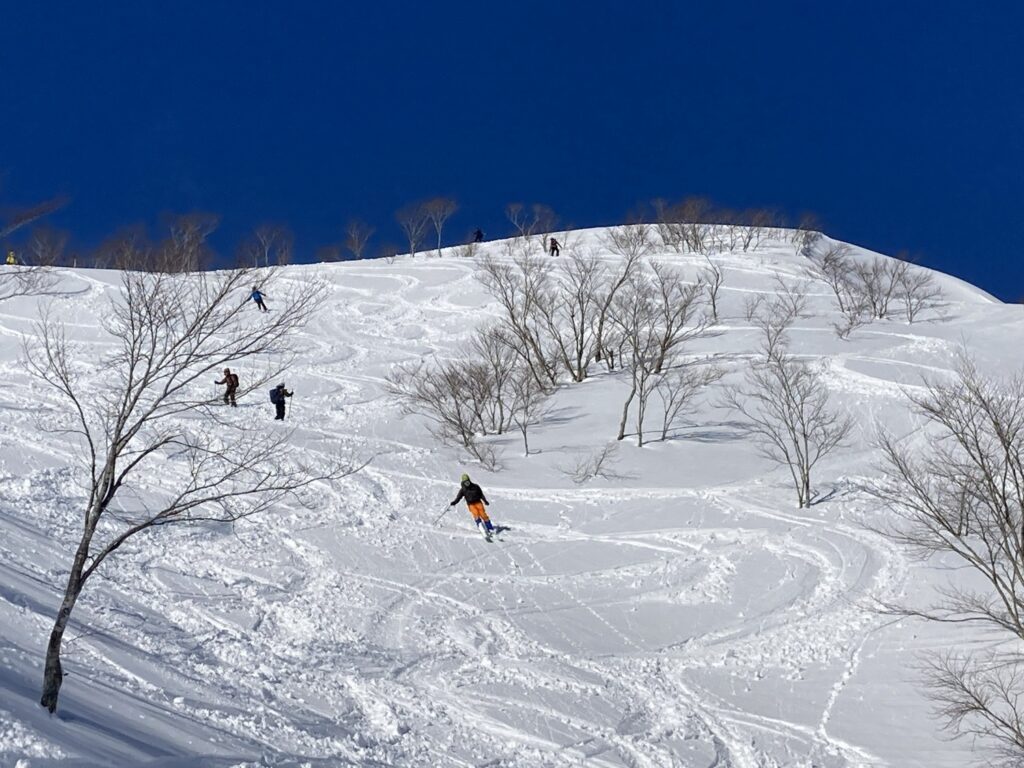
Powder puffed up to our knees. With every turn we carved, a light plume of spindrift rose. The snow was as light as feathers, and each time our skis brushed the surface, a faint shoosh rang out. This is the true pleasure of backcountry skiing. Regardless of skill level, everyone was savoring this snow.
U skied calmly, not at all like someone on their second backcountry ski tour. S went down steadily in wakan. There must have been frustration on her face, but she did not voice a single complaint.
We threaded through the beech forest, a white slope unfolding between the trees. The forest we had looked up at that morning, we now looked down on as we skied. It was the same scenery, yet a change of viewpoint made such a different impression.
Before long we came out onto an open slope in the forest. Time for seconds.
We decided to skin back up through this forest. The snow was too good to leave behind. We wanted to feel it one more time, and everyone felt the same.
S offered to head down ahead of us and wait at Shizu Onsen while we enjoyed our second run. We were grateful for the offer. Her consideration gave us the time to ski without holding back.
We put the skins back on and began climbing again, this time up the forest we had just skied. The same place looked entirely different going up than coming down. The climb back is hard. But thinking of the joy of skiing it again, even the effort felt good.
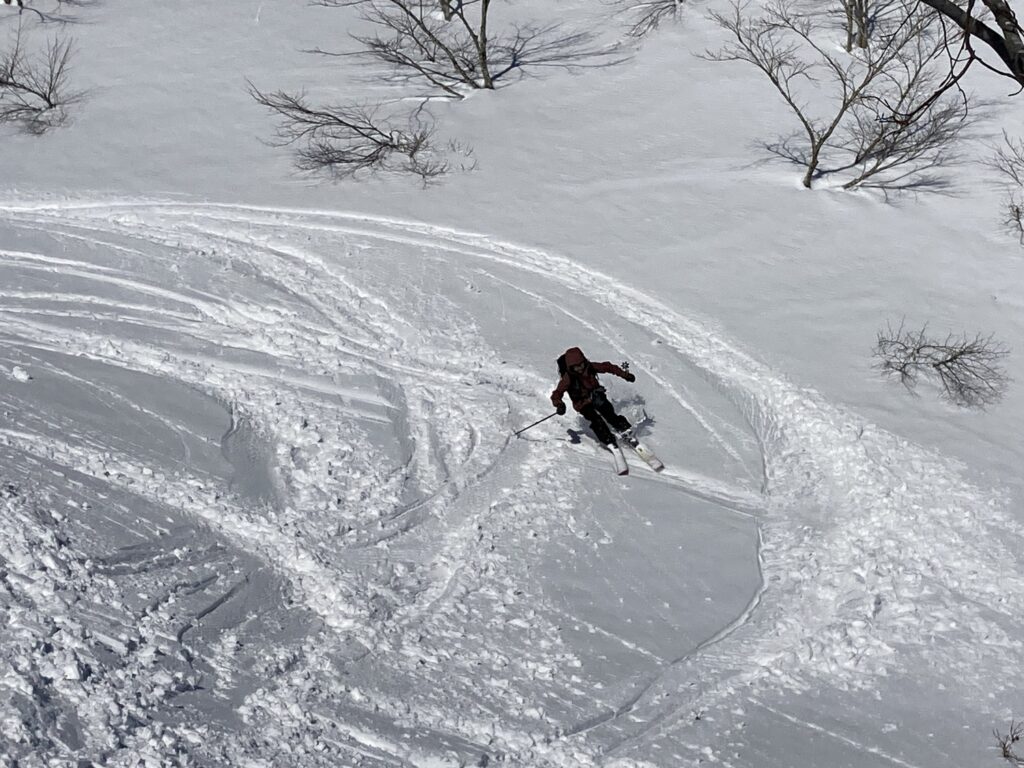
By the time we reached the top of the forest, our bodies were damp with sweat. And then we skied down once more.
The second run through the forest offered a different kind of enjoyment from the first. There was the exhilaration of skiing a slope that already held our tracks. The snow was as good as before, and we enjoyed the powder to the full. Using the line we had learned on the first run, we skied more smoothly and faster. The sensation of our skis slicing through the surface at speed rushed through my whole body.
When we got back to the Nature Center, we took another short break. It was a little past 2:00 PM.
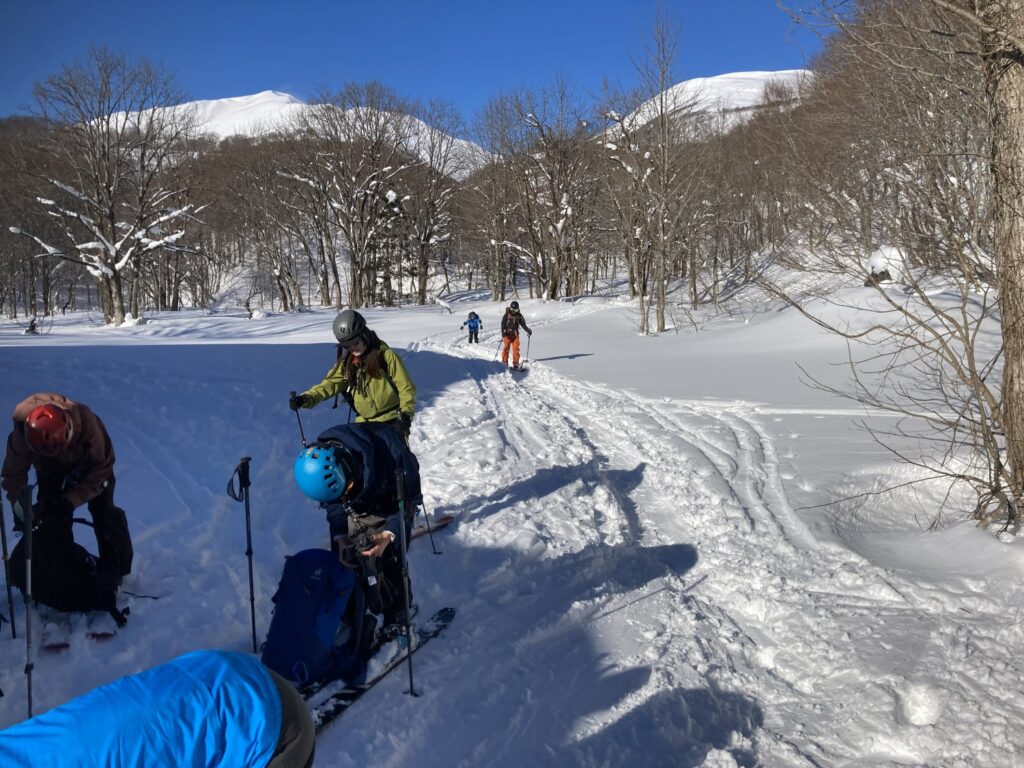
From here on it was an almost flat forestry-road walk. We moved along in a motion closer to skating than gliding. S’s pace in wakan was not much different from our own.
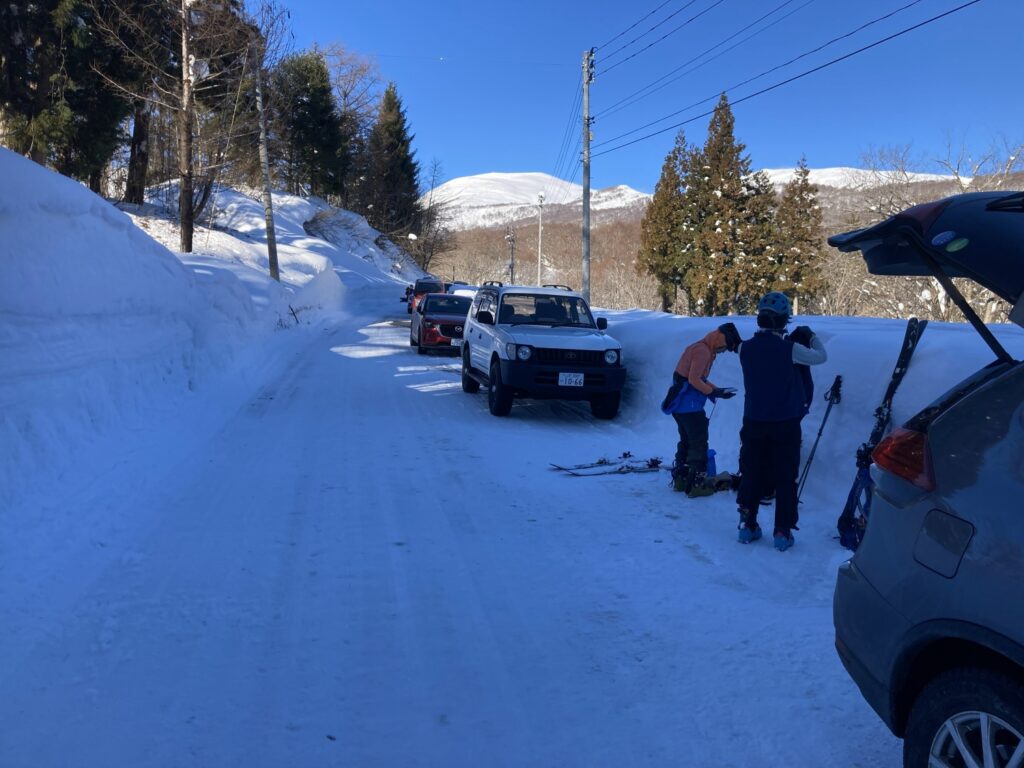
We passed the bus stop in front of the Shizu Campground and approached our parking spot at the end of the plowed section. At 2:19 PM, we completed our descent safely.
Activity time was about six hours. It was by no means a long tour, but the content was rich.
S’s binding trouble was unexpected, but her response and judgment kept the tour going. Our decision to avoid the east face and take the Southeast Ridge also proved right in the end, since everyone came down without injury and had a good time doing it.
Back at the car, as I packed away the gear, I reflected on the day. On Coming of Age Day, while young people across the country were celebrating a new start, we were in the mountains. Each person’s milestones differ, but the feeling that draws us toward the mountains is the same.
The beech forest of Mt. Yudono-san welcomed us in its winter stillness, and then saw us off. Blessed with powder snow, Mt. Yudono-san gave us the full joy of backcountry skiing.
Given the bad weather that arrived the next day, we were fortunate to have made the tour on this day. I am grateful to have spent the first day of the long weekend on Mt. Yudono-san with eleven companions.
As I left Shizu Onsen behind, my mind was already turning to the next tour.
LOG SUMMARY
The GPS data published in this article is only a record of that day. Please keep the following in mind:
Backcountry skiing is a world of personal responsibility. Put safety first and enjoy it.