【Deep Dive Essays】Cultural Etiquette for Hikers in Japan - Trail Manners, Shrine Etiquette, and Social Norms
北村 智明
稜線ディープダイブ

The fitness that hiking demands is hard to build through everyday life. Strain on the knees, long hours on your feet, thin air. How do you build a body that can handle all of this? This article lays out a step-by-step training approach that even people with no exercise habit can start without overreaching.
Article Info
- Level: Beginner
- Audience: People who want to start hiking, or who have been hiking for less than a year
- Article type: Technical guide
- Keywords: hiking training, building fitness, for beginners
You sometimes hear people say, “If you want to climb mountains, just train on the mountains.” There is some truth in that, but it is advice from experienced hikers. A beginner who tries to build fitness on a full-scale mountain from day one raises the risk of injury.
Hiking puts more load on the body than most people expect. A day hike with 1,000m of elevation gain is equivalent in effort to walking more than 10 km on flat ground. On the descent in particular, your knees absorb an impact of three to four times your body weight. Ordinary daily life almost never exposes you to a load like this.
Hiking without enough fitness takes the joy out of it. You are out of breath, your legs will not move, and you have no energy left to enjoy the view. You may also worry about holding up your companions. Above all, the decline in judgment that comes with fatigue can lead to accidents such as losing the trail or taking a fall.
Proper training greatly reduces these risks. With three months of preparation, even someone with no exercise habit can build the fitness to safely enjoy a mountain with roughly 800 to 1,000m of elevation gain.
The fitness hiking demands is not simply a matter of muscle strength or endurance. Four elements work together.
This matters most on long climbs. As elevation increases, oxygen concentration falls and the load on your heart and lungs rises compared with flat ground. On a 3,000m peak, the air holds only about 70% of the oxygen available at sea level.
With insufficient cardiovascular fitness, you run out of breath quickly and need to rest more often. Your moving time stretches out, and you risk failing to get down before sunset.
On the ascent, the quadriceps (the front of the thigh) do most of the work. On the descent, the quadriceps and hamstrings (the back of the thigh) share the load. Absorbing impact on the way down in particular requires solid strength.
Weak legs lead to knee pain and falls. The state Japanese hikers describe as “knees laughing” (hiza ga warau), when your legs begin to shake uncontrollably, signals that your muscles have reached their limit.
Hiking on uneven ground demands balance. With a weak core, the weight of your pack pulls your posture out of line and you waste extra energy.
On rock sections and chain sections (kusari-ba), core stability is directly tied to safety. If you cannot hold your trunk steady while moving with three points of contact, the situation becomes dangerous.
You need the stamina to keep going for six to eight hours. This is not a single element but the combined result of cardiovascular fitness, muscular endurance, and energy metabolism.
In daily life, we rarely move continuously for several hours. This lack of the ability to keep moving for a long time is the biggest wall for beginners.
Relative importance of each element (out of 100)
| Element | Importance | Why it matters |
|---|---|---|
| Cardiovascular fitness (aerobic capacity) | 95 | Most important on long climbs. Oxygen thins with elevation, so the load on heart and lungs increases. |
| Leg strength (strength and muscular endurance) | 90 | Drives the ascent and absorbs impact on the descent. Weak legs lead to knee pain and falls. |
| Whole-body endurance | 85 | The ability to keep moving for six to eight hours. Rarely developed in daily life. |
| Core stability | 70 | Balance on uneven ground. Directly tied to safety on rock sections. |
Training point: The four elements are not independent of one another. Aerobic exercise that builds cardiovascular fitness also improves whole-body endurance, for example. Training them in balance makes for safe and comfortable hiking.
You can build hiking fitness without going to the mountains. Training three to four times a week for 30 minutes to an hour produces steady results.
Walking and Jogging
This is the easiest and most effective option. Start with a 30-minute brisk walk. The ideal pace lets you hold a conversation while breathing a little harder than normal.
After two weeks, extend the sessions to 40 minutes, then 50. After a month, you can mix in some light jogging. The key is to stay just short of the intensity where it starts to feel “hard.”
Stair Training
This has a direct payoff for hiking. Use the stairs at a station or in a building, going up and down at a slow, steady pace. Aim for 10 to 15 minutes.
The descent is hard on the knees, so do not push it. If you feel pain, switch to climbing only.
💬 TOM: Try swapping escalators and elevators for stairs.
Cycling and Swimming
Both are easy on the knees and build cardiovascular fitness. If you have concerns about your knees, make these your main activities.
Squats

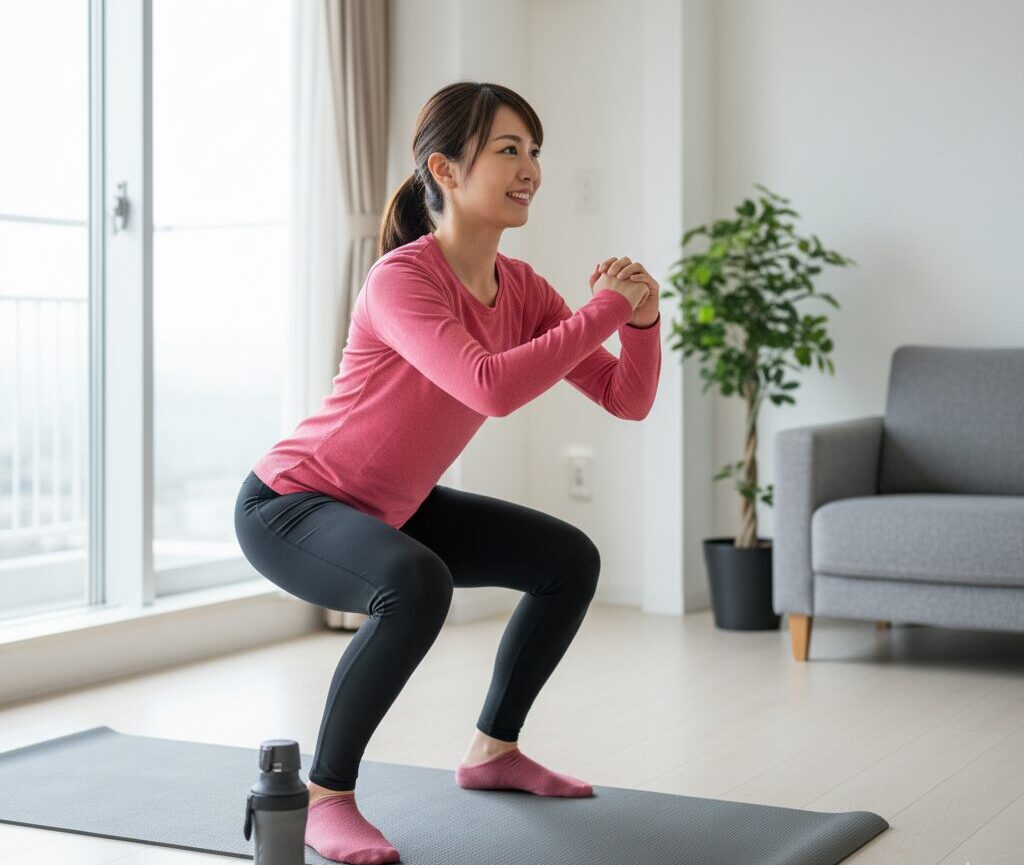
This trains the muscles you use most in hiking. Stand with your feet shoulder-width apart and lower your hips without letting your knees travel past your toes. Do three sets of 10 to 15 repetitions.
Start with shallow squats. If your form breaks down, reduce the repetitions. As you get used to the movement, add load by slowing it down.
Lunges

Step forward with one leg and bend the knee. Do two to three sets of 10 repetitions per side. This builds the ability to absorb impact on the descent.
Calf Raises

Rise onto your toes, then lower your heels. This strengthens the calves and improves ankle stability. Do three sets of 20.
Planks

This is the foundation of core training. Hold a push-up position on your elbows for 30 seconds to one minute. Take care not to let your back arch.
Flexibility helps prevent injury. It is especially important to maintain the range of motion in your hips, knees, and ankles.
Stretching is most effective when your body is warm, such as after a bath. Hold each stretch for 20 to 30 seconds, only as far as you can go without pain.
Once daily training has built your base fitness, move on to practical training on a real mountain. It is also a chance to check your gear and learn how to pace yourself.
First outing: 300–500m of elevation gain, 2–3 hours round trip
Start with a short hike to check your fitness and your gear. Look for a mountain with a clear trail from trailhead to summit and several escape routes.
A popular mountain near a city will have plenty of other hikers, which is reassuring if something goes wrong.
Second outing and beyond: 500–800m of elevation gain, 4–5 hours round trip
Gradually increase distance and elevation gain. At this stage, get a feel for hydration, eating trail snacks (kōdōshoku), and pacing.
Step-up: 800–1,000m of elevation gain, 5–7 hours round trip
This is the standard level for a day hike. Once you reach it, you have the fitness to handle many mountains.
💬 TOM: A little reward after the descent is perfectly fine, too.
Pacing
Start especially slowly. A pace that feels “almost too easy” is about right. If you rush the first 30 minutes, you will tire sharply later on.
Keep a pace that does not leave you breathless, and walk in a steady rhythm. “Slow and long” is the foundation of hiking.
Taking Breaks

A common pattern is to walk for 50 minutes and rest for 10. Beginners, however, can rest for 5 to 10 minutes every 30 to 40 minutes.
Always drink water and eat trail snacks during breaks. Refueling before you feel tired is the key to preventing a sudden loss of energy.
On the Descent
The descent is hard on the knees. Shorten your stride and avoid bending your knees too deeply.
Late in the descent, as fatigue builds, the risk of falling goes up. Do not rush; place each step with care.
Effective training needs a plan. Set a goal and raise the intensity in stages.
Month 1: Building a Base
Month 2: Raising the Intensity
Month 3: Practical Training
| Period | Focus | Low-mountain practice |
|---|---|---|
| Month 1 (Weeks 1–4) | Base fitness. Start with 30 minutes of aerobic exercise and extend gradually. | 300–500m of elevation gain |
| Month 2 (Weeks 5–8) | Higher intensity. 40–50 minutes of aerobic exercise, heavier strength work. | 500–700m of elevation gain |
| Month 3 (Weeks 9–12) | Practical training. Target mountain in the final week. | 700–1,000m of elevation gain |
Doing Too Much, Too Soon
Starting with high-intensity training leads to injury and discouragement. It is wiser to begin at a level that feels “almost too easy” and raise the load every two weeks.
Irregular Training
Short, regular sessions work better than cramming everything into the weekend. Three 30-minute sessions a week produce better results than one two-hour session.
Too Little Rest
Muscles grow while they rest. Taking sensible rest days is more effective than training hard every day.
Neglecting Nutrition and Sleep
Food and sleep matter as much as the training itself. Make a point of eating enough protein and get seven to eight hours of sleep.
💬 TOM: Logging your outings on Yamareco or YAMAP is a great motivation boost!
Training Points
Step-by-Step Progression
Tips for Staying Consistent
Building hiking fitness requires no special talent or facilities. By accumulating small efforts in everyday life, anyone can build a body that can enjoy the mountains. What matters is to take it step by step, at your own pace, without rushing.
💬 TOM: Building muscle makes you look leaner than your weight suggests, so it is a healthy way to lose weight, too.
Once you have built your fitness, head for a real mountain. The following articles introduce recommended mountains for beginners and explain how to carry out a day hike.
NEXT STEP 01 — 5 Beginner-Friendly Hikes in Japan
Carefully selected mountains that beginners can climb with confidence after training, introduced by difficulty level.
NEXT STEP 02 — The Complete Guide to Day Hiking
From planning to the day itself: practical know-how for enjoying a day hike safely.
This article is intended for people in general good health. If you have a medical condition or have been told by a doctor to limit exercise, please consult a professional before starting any training.