【Deep Dive Chronicle】Central Buttress of Ichinokura-sawa: A Day After the Exam, Onto the Wall
北村 智明
稜線ディープダイブ
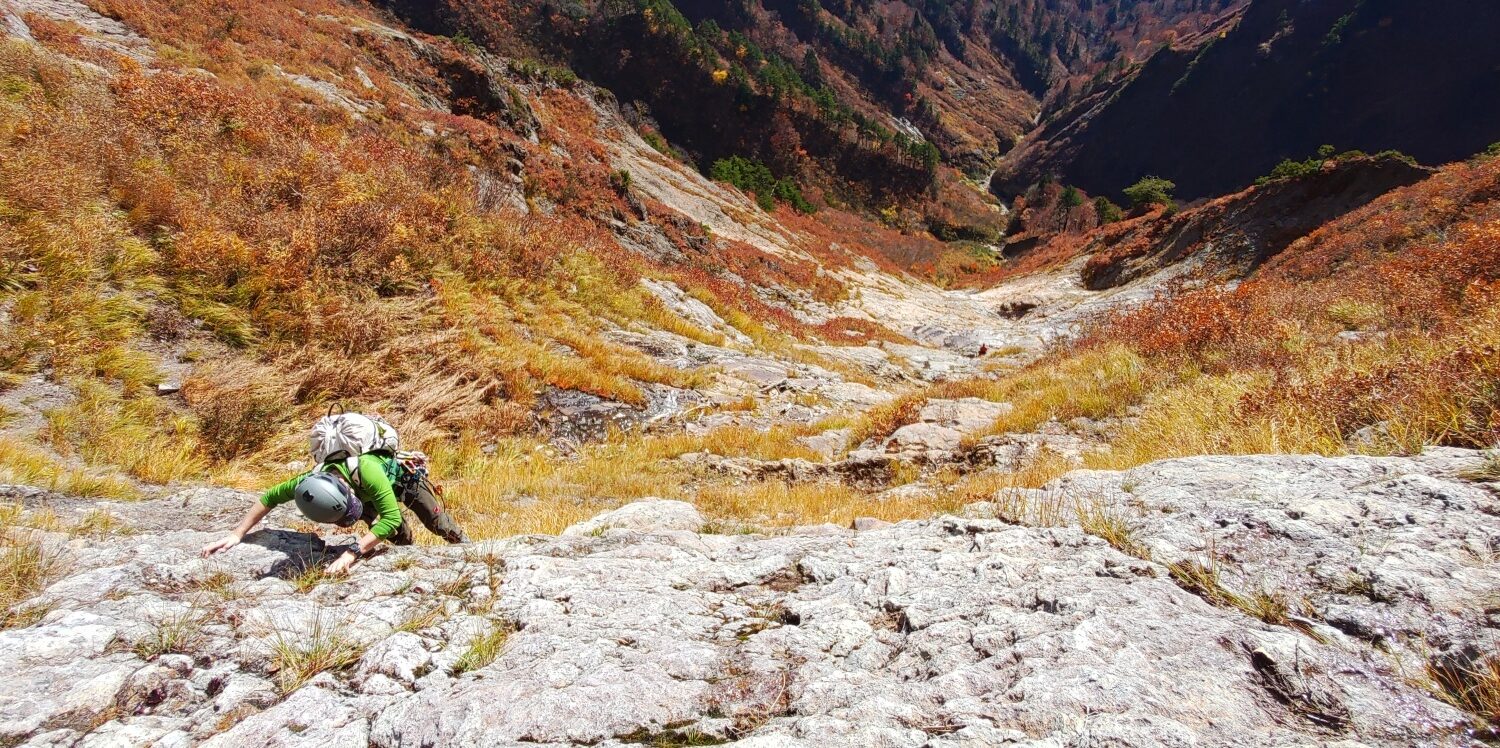
To Honnamikagura’s Mt. Maegadake South Wall. Targeting the second gully (runze) among the granite slab formations spread across the headwaters of Kirikizawa. Climbing 600 meters of towering rock wall via free climbing, gazing down at the autumn foliage of the Kaietsu region. A late autumn rock climbing chronicle concluding three days of mountain adventures.
The previous day, after completing two days of instruction in Nishi-Joshu, I drove from Gunma Prefecture to Niigata. My destination was Mt. Maegadake South Wall in Honnamikagura.
As dusk fell, I arrived at the trailhead. This expedition involved five climbers—companions separate from the instructional group. I spent the night in my car, awaiting the morning. Three consecutive days of mountain activities—fatigue was certainly present, but my body could still move.
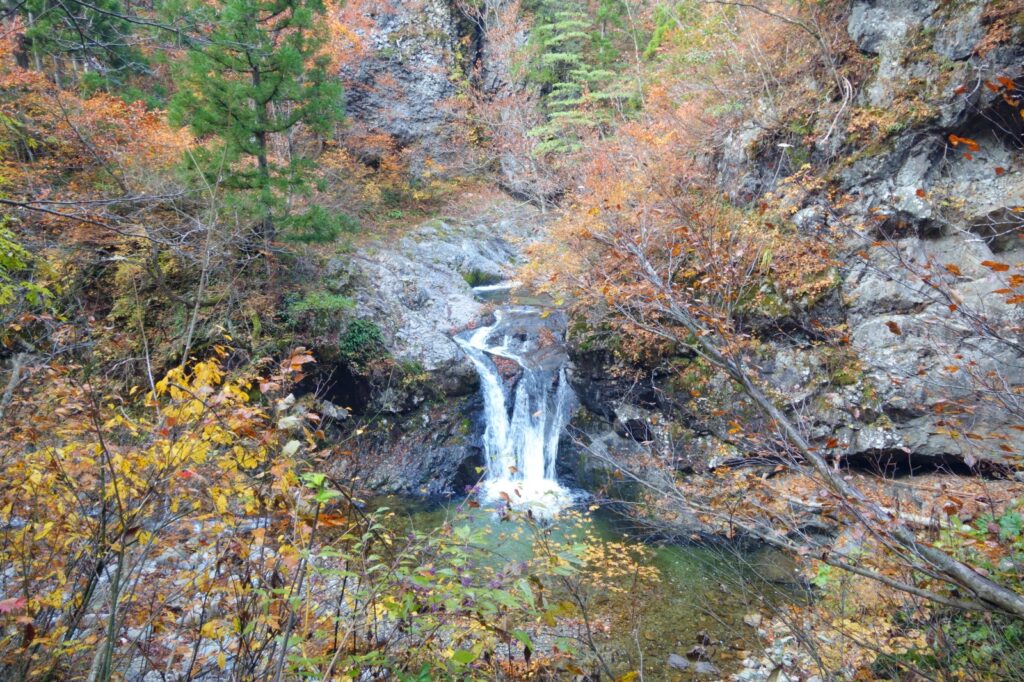
On November 6th, we departed at dawn. Passing Yaotome Falls, we ascended the trail known as Hatchō-senban. Autumn foliage was reaching its end, with fallen leaves covering the path.
The rock face known as Mt. Maegadake South Wall lies enclosed by two mountain ridges: the Sugiyama-ga-saki (cape) ridge extending south from Honnamikagura-dake, and the prefectural border ridge called Maegadake Five Peaks leading to Yakebotoke-dake. The granite slab formations spreading across the left bank of Kirikizawa headwaters are distinctly divided into four V-shaped sections at their eastern end. We were targeting the second slab.
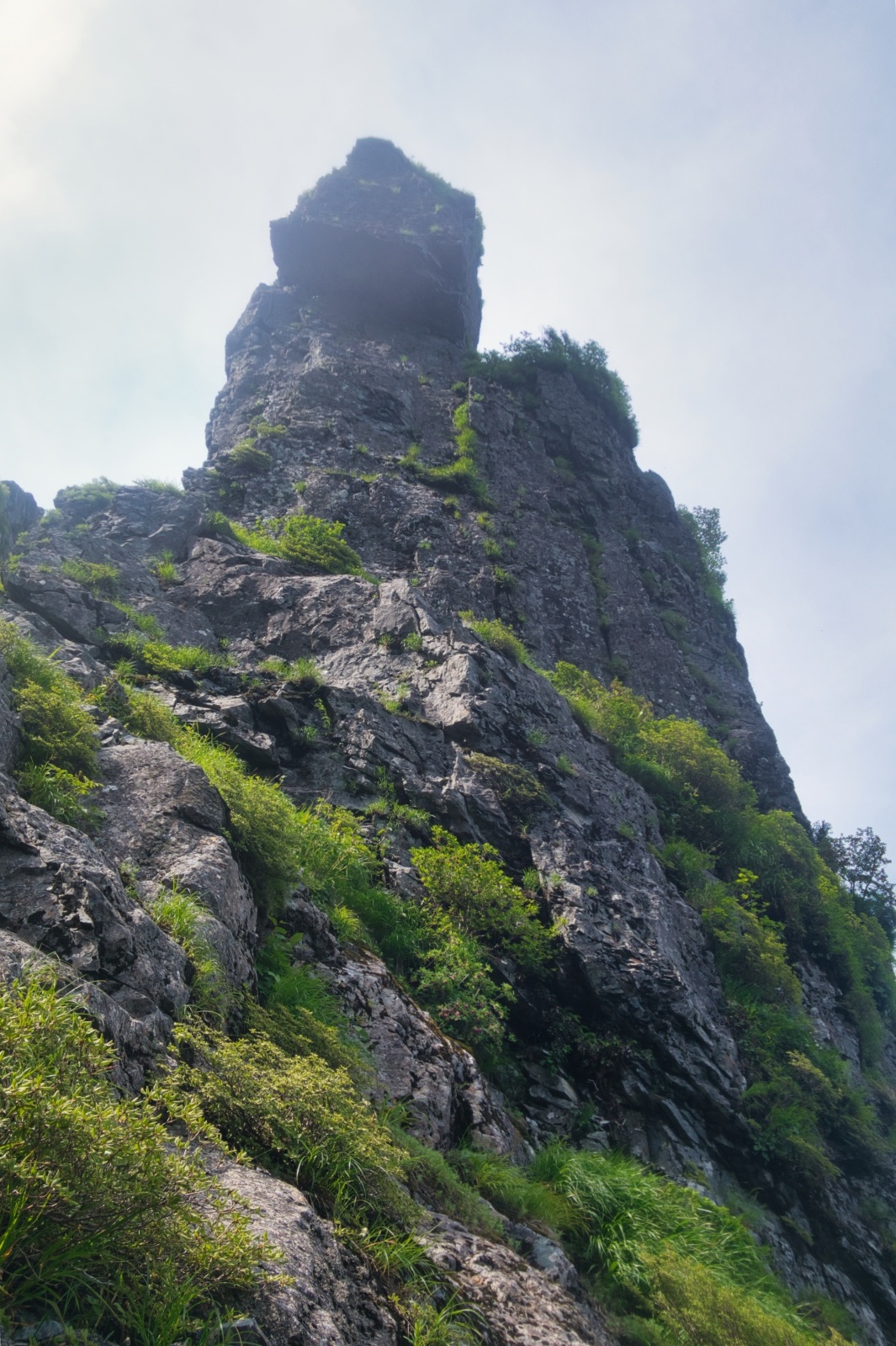
Near the base of the Sugiyama-ga-saki ridge, we left the main trail. Descending into the valley, we eventually reached the base of the rock wall. Looking up, white granite walls pierced the sky. A 600-meter elevation gain. The V-shaped gully-like (runze) slab awaited us.
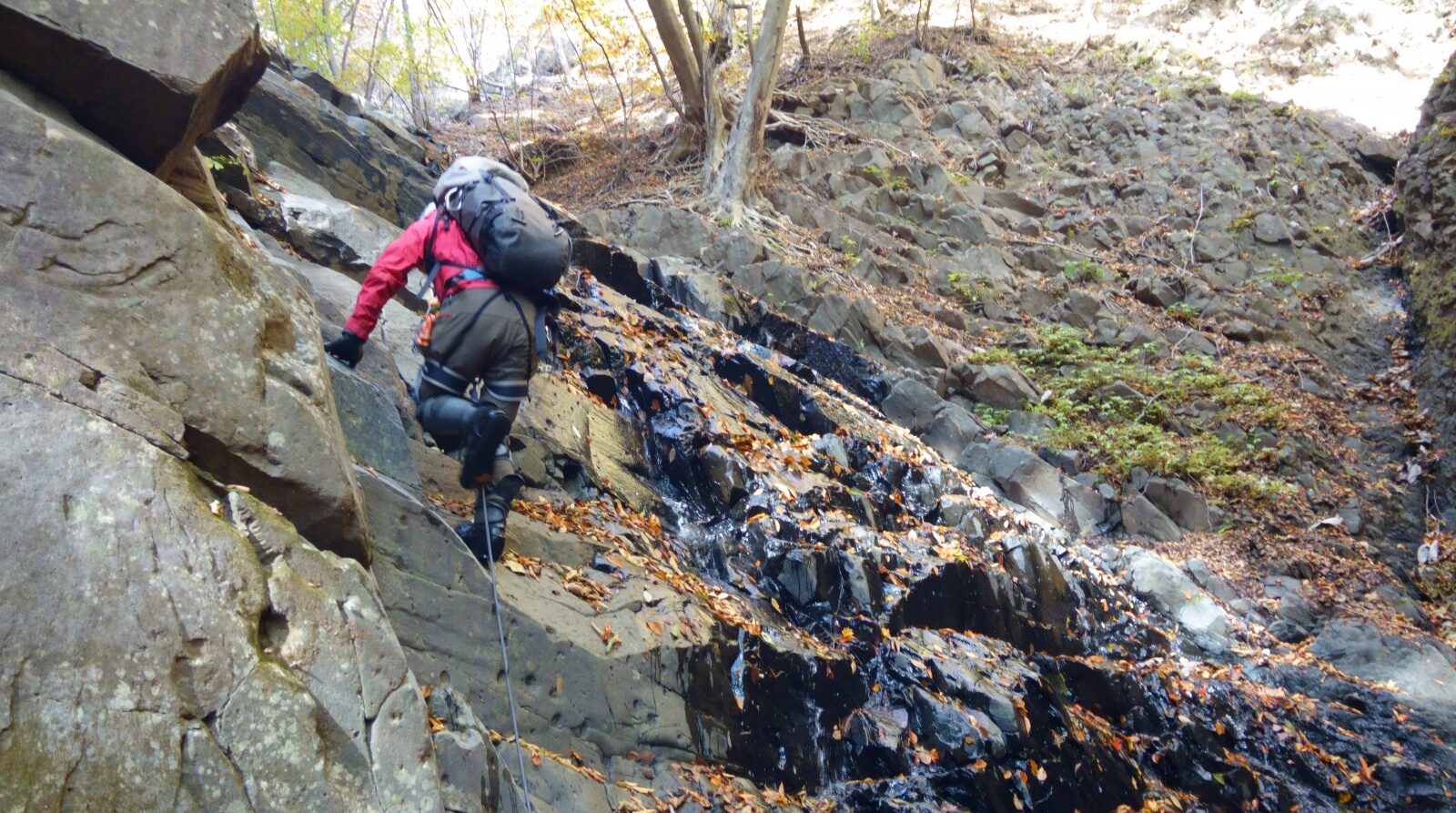
Standing at the base, I tested the rock’s texture. The characteristic rough surface of granite felt pleasant against my fingertips. Friction was good. However, there were spots with sand and friable rock. We began our ascent, carefully assessing the rock quality.
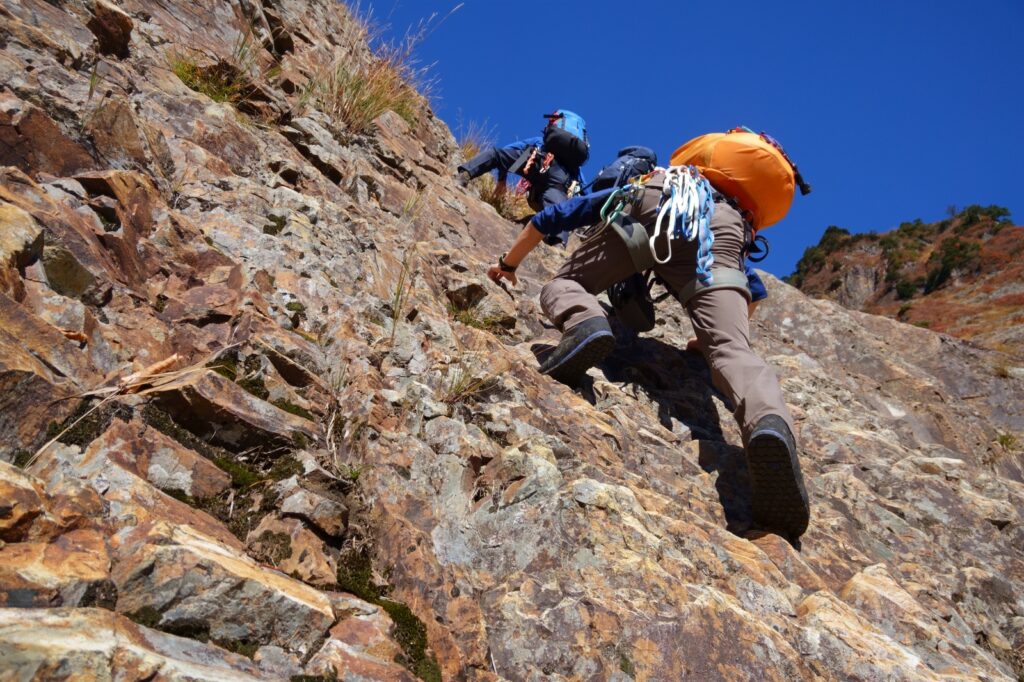
V-Gully Second Slab presents no significant technical difficulty. The climbing grade ranges from II to III (Based on Japanese Alpine Club/Local Standard). There’s no identifiable crux section, and we used rope minimally. We pitched out only one section as a precaution—essentially free climbing throughout.
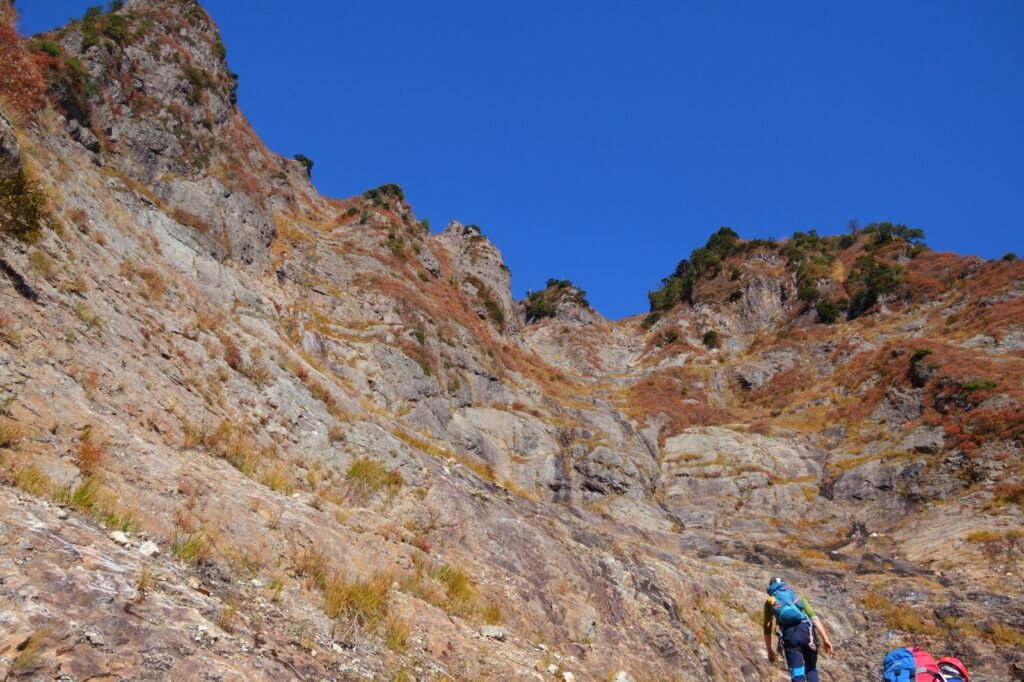
The open exposure while ascending the slab—this is the route’s true appeal. Though holds aren’t abundant, we climbed trusting the friction. A dialogue with rock. Sharpening the sensation in our soles, maintaining balance as we gained elevation.
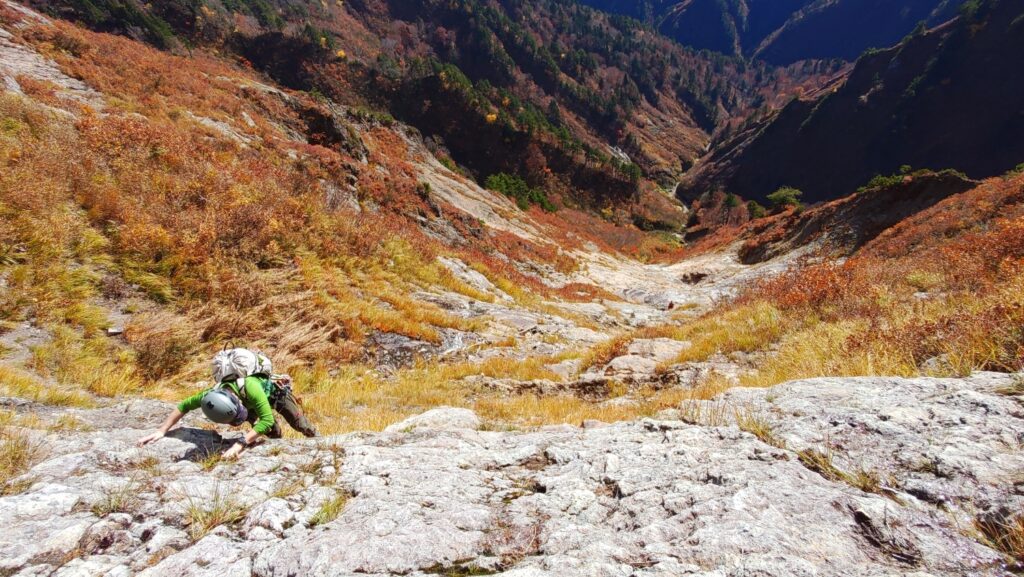
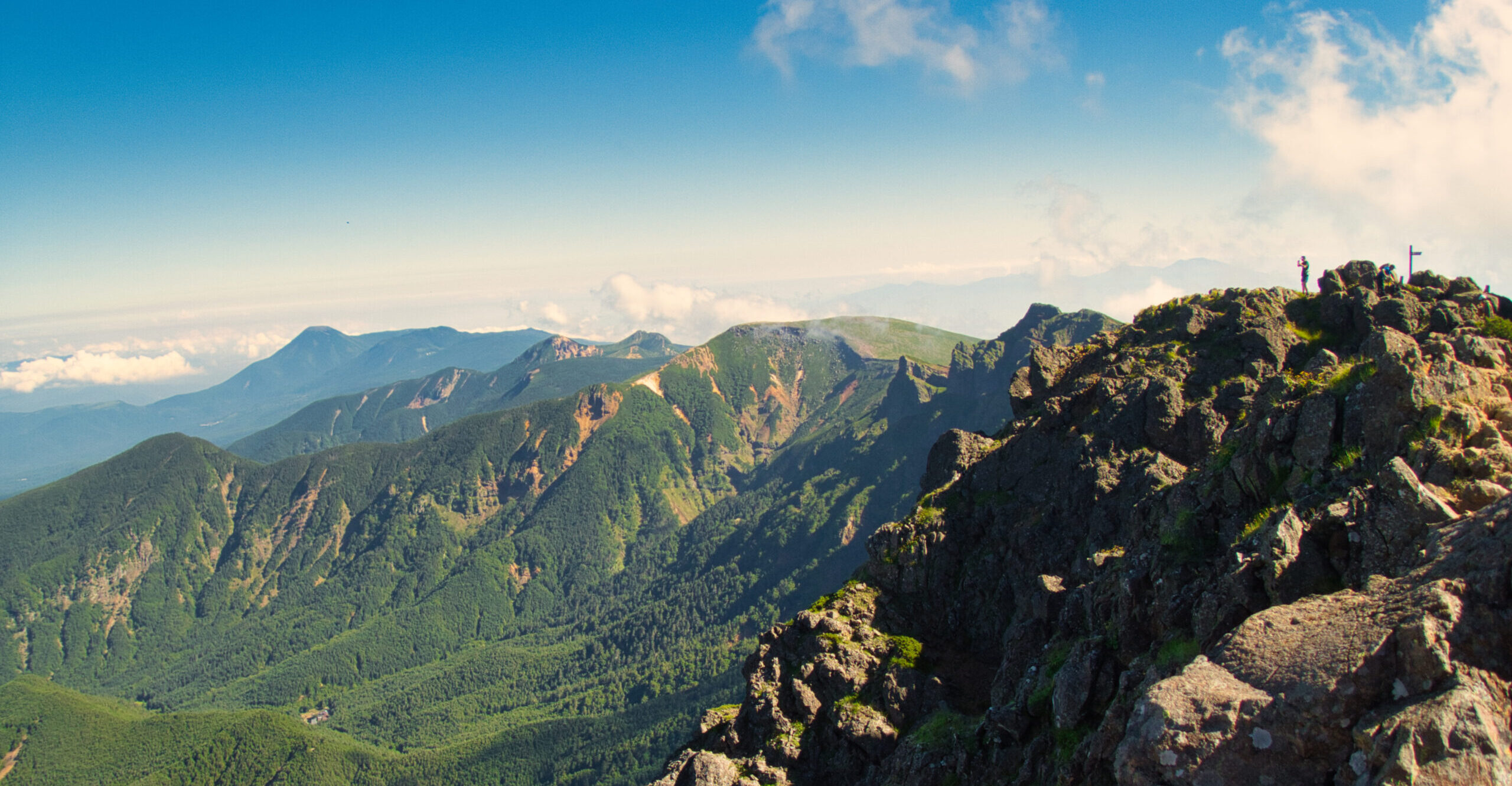
Each time I paused for breath, I turned around. Spread below was the vast granite slab. White rock face gleaming in sunlight, beyond which stretched the mountains of Kaietsu. Late autumn foliage colored red and yellow.
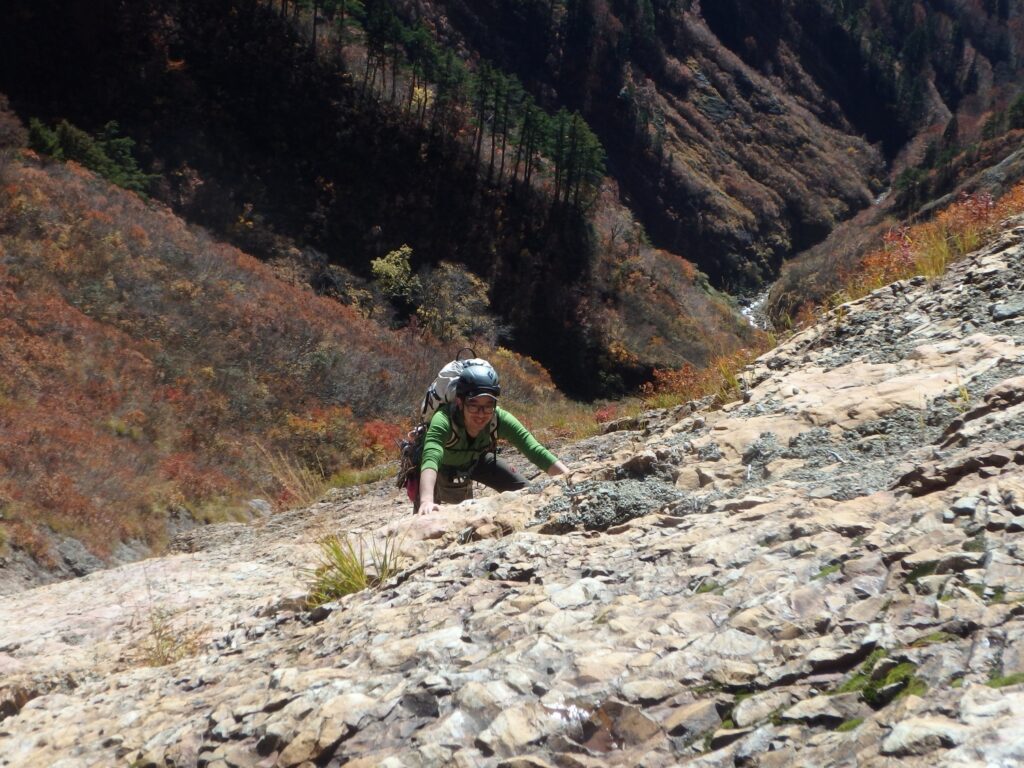
The higher we climbed, the more the vista opened. Ascending the V-shaped runze to reach the slab’s upper section, the scenery transformed completely. The entire expanse of Maegadake South Wall spread below. We had climbed 600 meters of rock wall. The magnitude of scale was overwhelming once again.
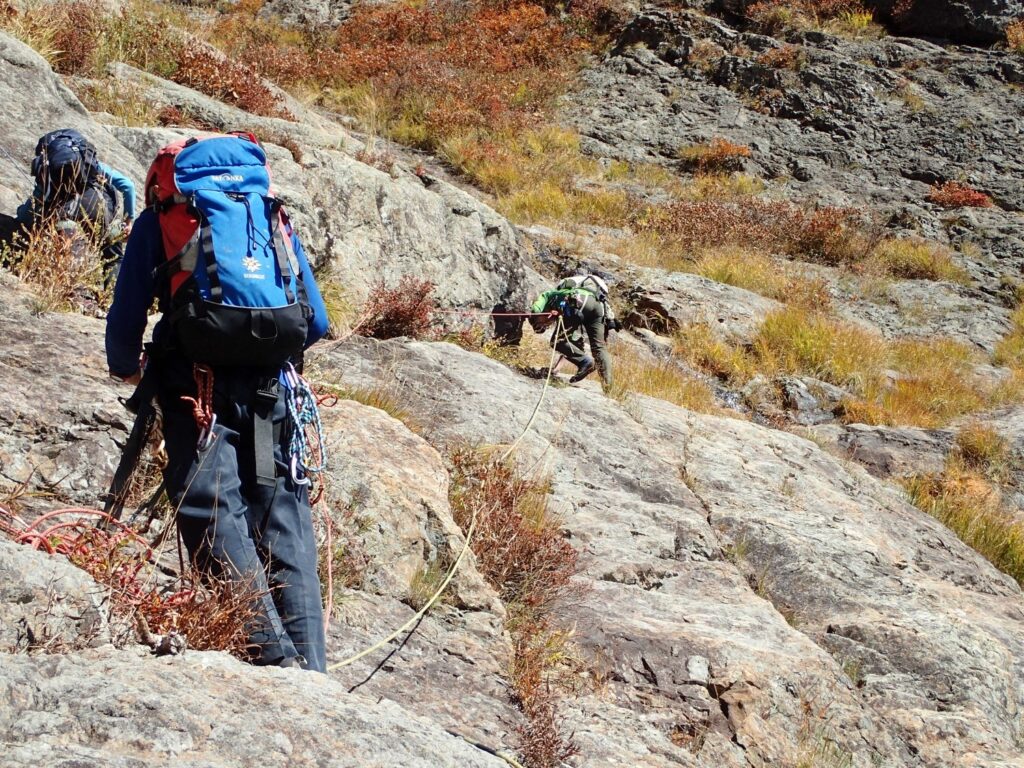
Calling out to companions as we continued our ascent. A direct dialogue with rock, different from the previous days’ stream climbing instruction. In a waterless world, confronting gravity. Though three days of fatigue was real, the joy of rock climbing helped us forget it.
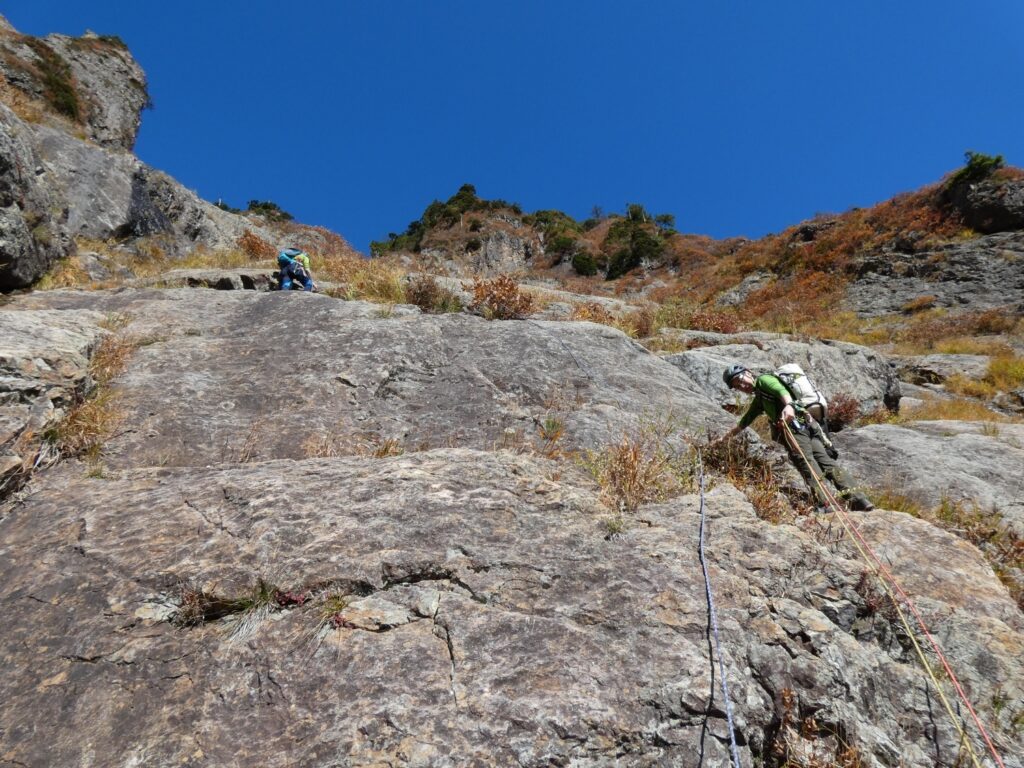
Eventually we reached the slab’s upper section. However, the climbing hadn’t ended. What lay ahead would be today’s true crux.
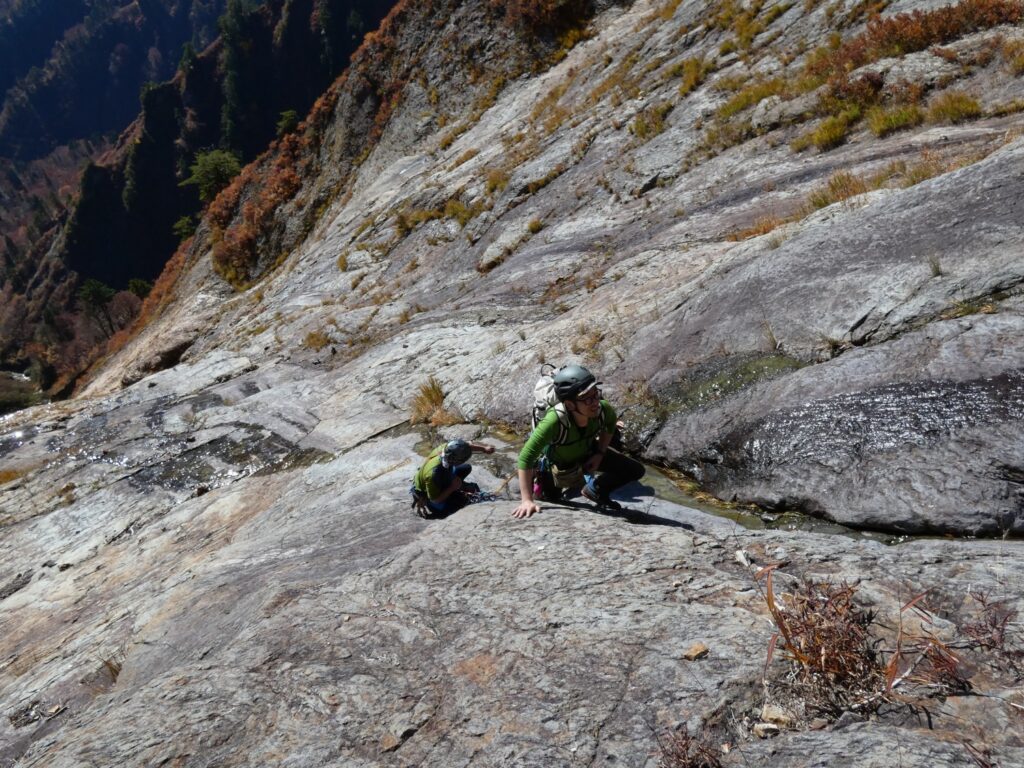
Beyond the slab awaited dense bushwhacking (yabukogi). Shrubs grew thick, blocking our path forward. Working together with companions, we parted branches and twisted our bodies through.
The bushwhacking continued for about thirty minutes. Emerging from the shrub zone, we encountered bamboo grass (sasa). Pushing through shoulder-high sasa, we finally reached the hiking trail. Near the Mikagura-dake refuge hut.
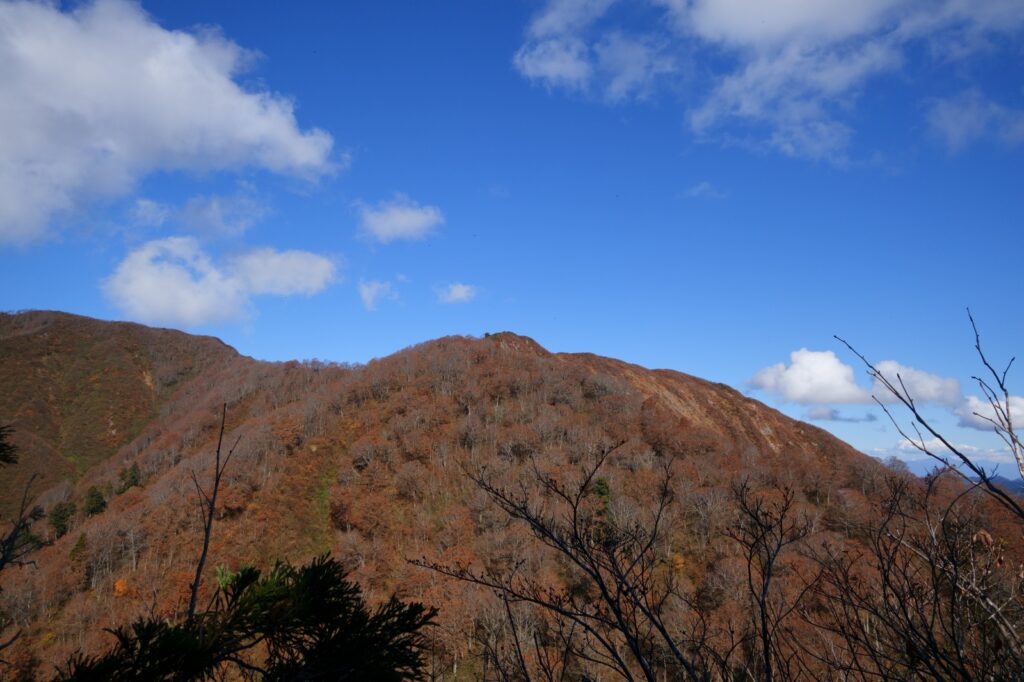
Wiping sweat, catching our breath. Though the climbing itself was comfortable, the bushwhacking’s toll was significant. Yet this too is part of mountain travel. Nature constantly presents unexpected difficulties.
Descending via the Sugiyama-ga-saki ridge, we retraced the Hatchō-senban trail. Fatigue weighing heavy on our legs, but we could only keep walking.
Descending Hatchō-senban, approaching the vicinity of Yaotome Falls, S discovered Nameko (Pholiota microspora) mushrooms. Small mushrooms clustering on fallen logs. A gift from the late autumn mountains.
We stopped to gather Nameko. Though the harvest wasn’t large, it was a small joy concluding three days of mountain activities. Gathering wild vegetables and mushrooms is also one of mountain’s pleasures.
Passing Yaotome Falls, we returned to the trailhead. Three days of mountain adventures finally reached their end.
Ura-Myogi’s Yakyu-zawa, Nishi-Joshu’s Usui River, and Honnamikagura’s Mt. Maegadake South Wall. Three days of continuous mountain activities combining stream climbing and rock climbing in different styles were physically demanding. But proportionate to that, much was gained.
Mt. Maegadake South Wall V-Gully Second Slab, while not technically difficult, offers appeal in its 600-meter scale and the comfort of open slab climbing. The white granite rock face spreading below, and Kaietsu’s autumn foliage. That scenery helped us forget climbing fatigue.
Leaving the trailhead, I drove toward Fukushima. The fulfillment of three days’ mountain activities, and the fatigue that had indeed arrived. Carrying these, I headed home.
Mountains constantly offer new discoveries and challenges. And we will head to the mountains again.
[LOG SUMMARY]
Basic Information:
Route:
Trailhead → Yaotome Falls → Hatchō-senban → Sugiyama-ga-saki Ridge approach → Descend to stream → V-Gully Second Slab (600m climbing) → Bushwhacking → Hiking trail near Mikagura-dake refuge hut → Sugiyama-ga-saki Ridge → Hatchō-senban → Yaotome Falls → Trailhead
Activity Stats:
Starting Point:
From Fukushima Prefecture → Moved from Gunma Prefecture to Niigata Prefecture on November 5th → Car camping at trailhead
Notable Features:
The GPS data published in this article is a record from the specific day of our climb. Please note the following: