【Deep Dive Chronicle】Suganedake: Suginomorisawa Hidarimata — An Autumn Stream Born from Change of Plans
北村 智明
稜線ディープダイブ
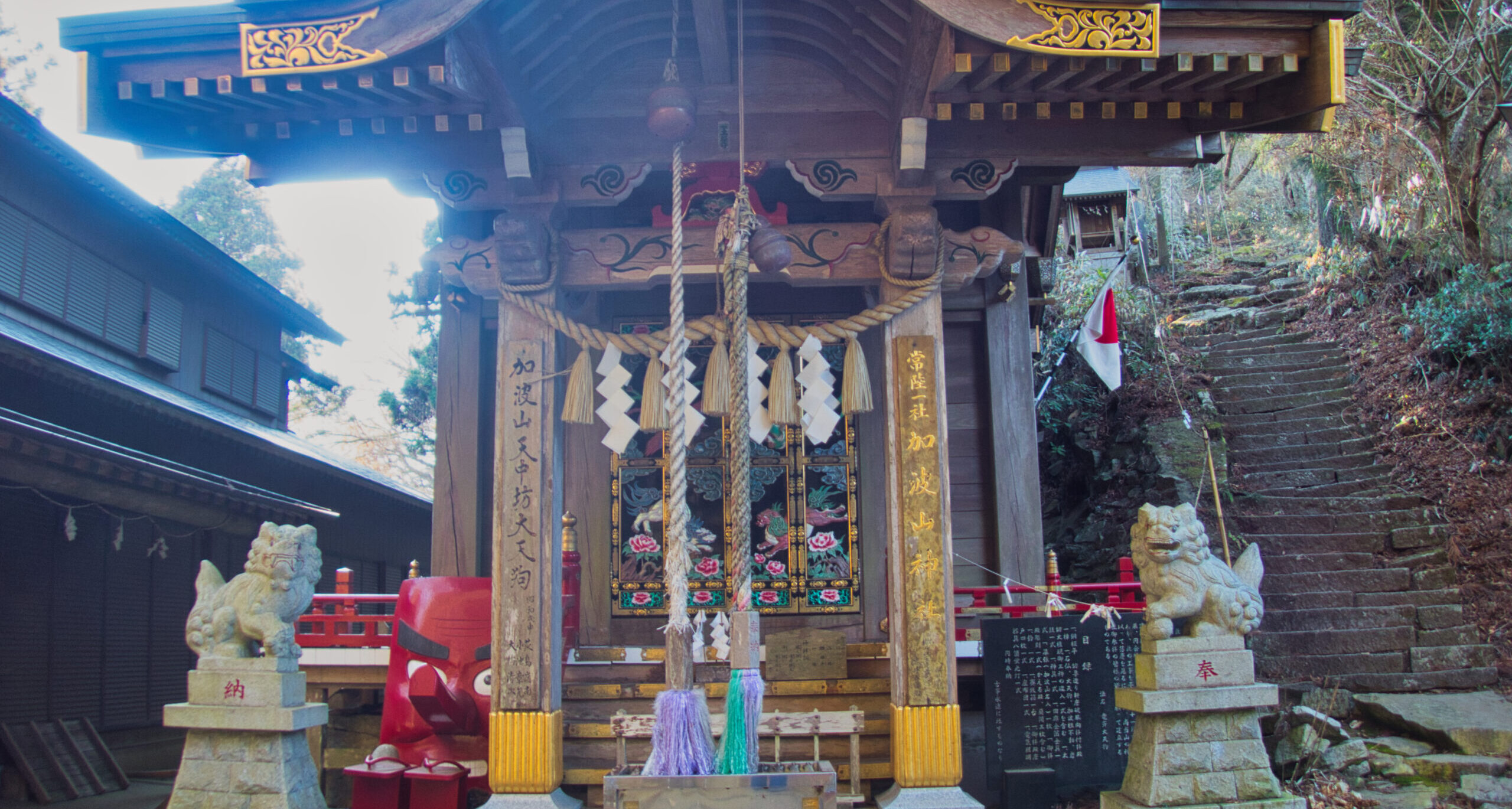
December. Clear winter skies over the Tsukuba Mountain Range. Kaba-san (Mt. Kaba), a celebrated peak of the Tsukuba Renzan, has long been revered as a sacred site of mountain worship — a world woven from tengu legend and towering stone. I spent a day guiding guests through this place of mystery and quiet history. A chronicle of a pilgrimage path etched into a winter lowland, where faith has worn the rock smooth.
I left Fukushima in the early hours. Dawn was still far off, and the temperature outside had fallen well below freezing. With the white ridgeline of the Azuma Renpo (Azuma Mountain Range) at my back, I headed south. As I drove the Joban Expressway, the sky gradually brightened. Turning off at the Sakuragawa-Chikusei Interchange, the silhouette of the Tsukuba Renzan (Tsukuba Mountain Range) appeared through the windshield. Lower in elevation than the mountains of Fukushima, yet standing with unmistakable dignity above the Kanto Plain.
At 709 meters, Kaba-san is the second-highest peak in the range after Mt. Tsukuba-san. Once recorded under the names Kamikoyama, Kambayama, and Kaniwa, this mountain has drawn the reverence of worshippers from across the Kanto region since antiquity. Kaba-san Jinja Hongu (Main Shrine) sits at the summit, and ascetic practitioners still perform their ritual traversals here today. The mountain is also known as the dwelling of the tengu — the great winged mountain spirits of Japanese folklore — and it is said that 737 deities are enshrined within its bounds.
In the seventeenth year of the Meiji era, a significant event unfolded on these slopes. A group of young men who had devoted themselves to the Freedom and People’s Rights Movement climbed to the summit in defiance of the Meiji government’s repression, raising a banner that read “Overthrow the Oppressive Government.” The Kaba-san Incident, as it came to be known, was met with swift and harsh suppression; many of those young men were tried and sentenced. A mountain of faith had also become the final stronghold of those who cried for liberty.
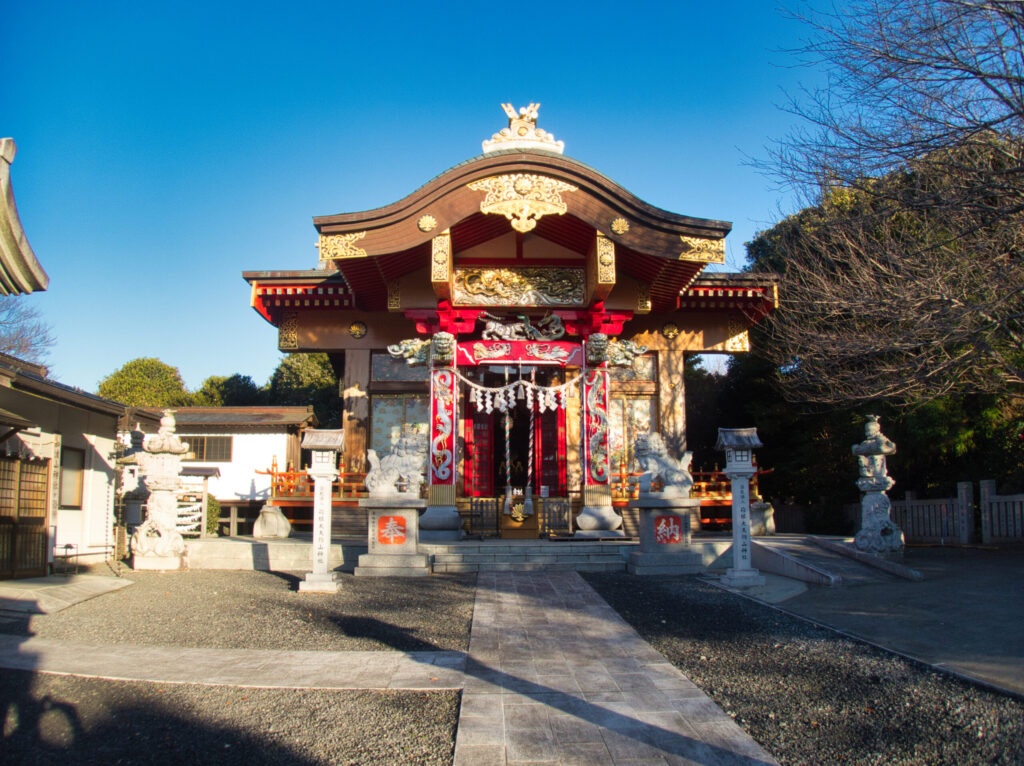
We gathered at Kaba-san Jinja Makabe Haiden (Makabe Worship Hall) to offer prayers for a safe journey. The vermilion shrine gleamed in the winter sunlight. As a guide, safety is always my first priority. I checked each participant’s equipment and assessed everyone’s condition — layering of insulation, water supply. The guests visiting this mountain for the first time wore expressions of anticipation mixed with a touch of nerves. A low mountain in winter, yes, but one with rocky terrain.
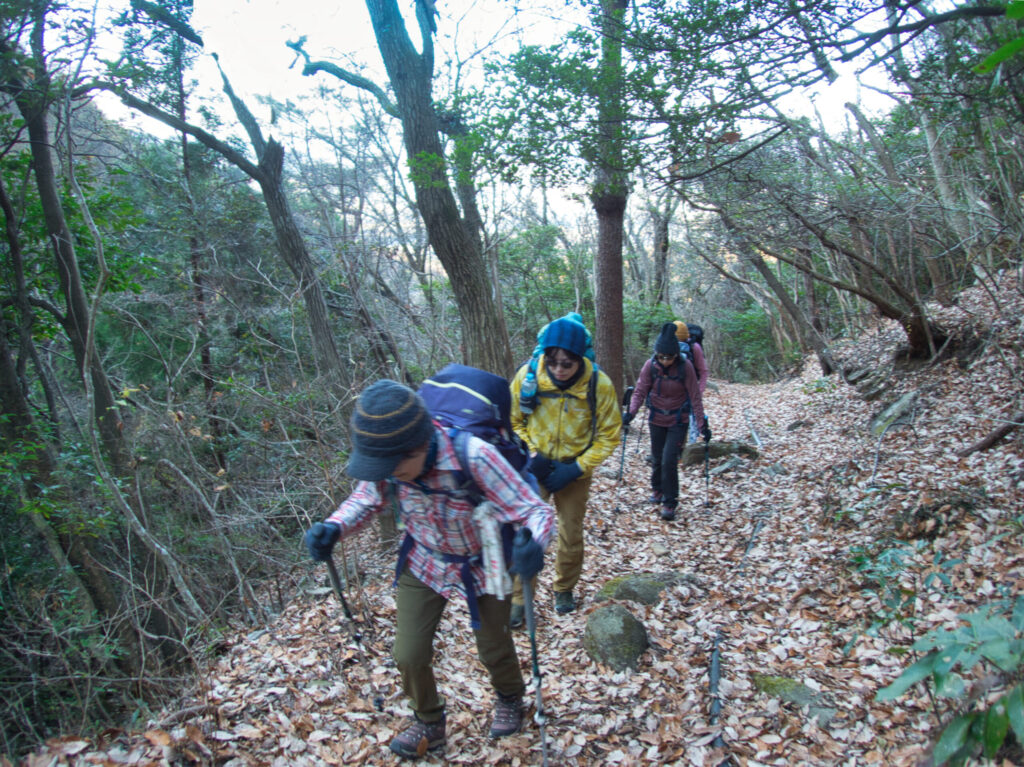
Just past eight in the morning, we set off from the third-station car park. The bare branches of konara oaks and kunugi chestnuts cut sharp lines against the brilliant blue of the winter sky. Their stripped simplicity seemed to embody the austere solemnity of a place devoted to practice — all ornamentation stripped away. The trail threading through the deciduous forest was thick with fallen leaves, and our footsteps fell quietly into the stillness. I watched the pace of each participant, pausing at measured intervals to rest.
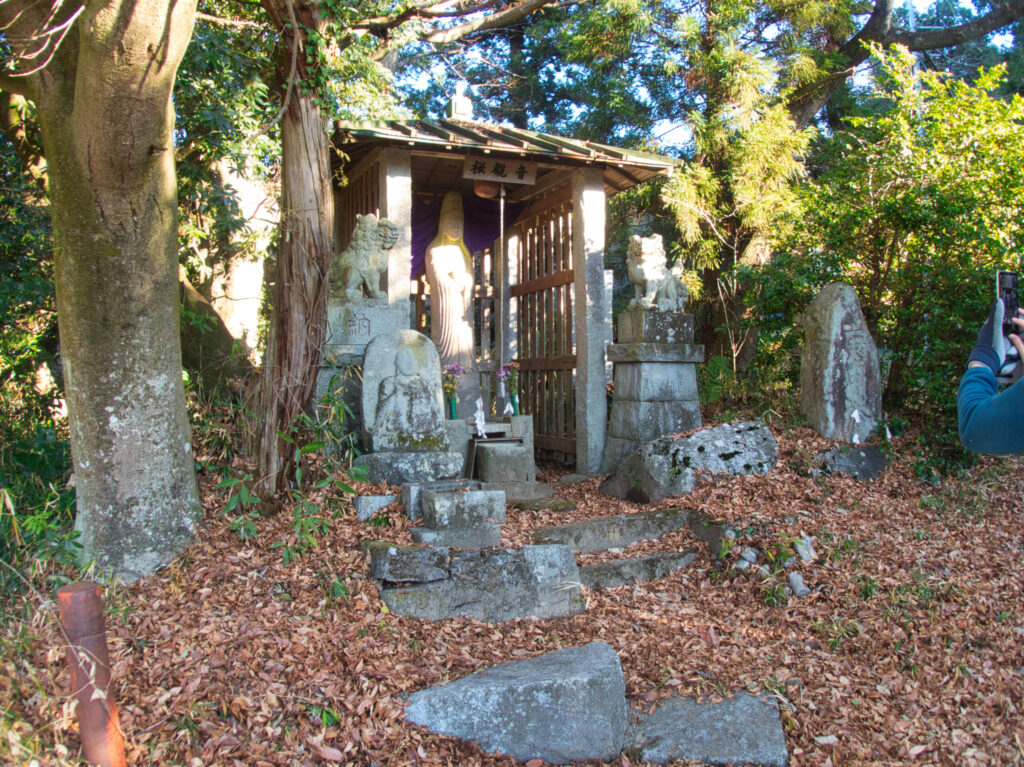
Before long, great boulders began to appear. Moss-covered granite megaliths spoke silently of the mountain’s sacred character. Along the path, countless stone monuments and small shrines stood watch, weathered and green with age. It is said that 737 deities reside on Kaba-san, and I found myself wondering who had carried each of these stones up the steep approach, and what prayers had accompanied them. The mountain — long feared as the tengu’s domain — had also served as a vast vessel, receiving the earnest supplications of countless ordinary people. That weight seemed to rise through the soles of my boots with every step.
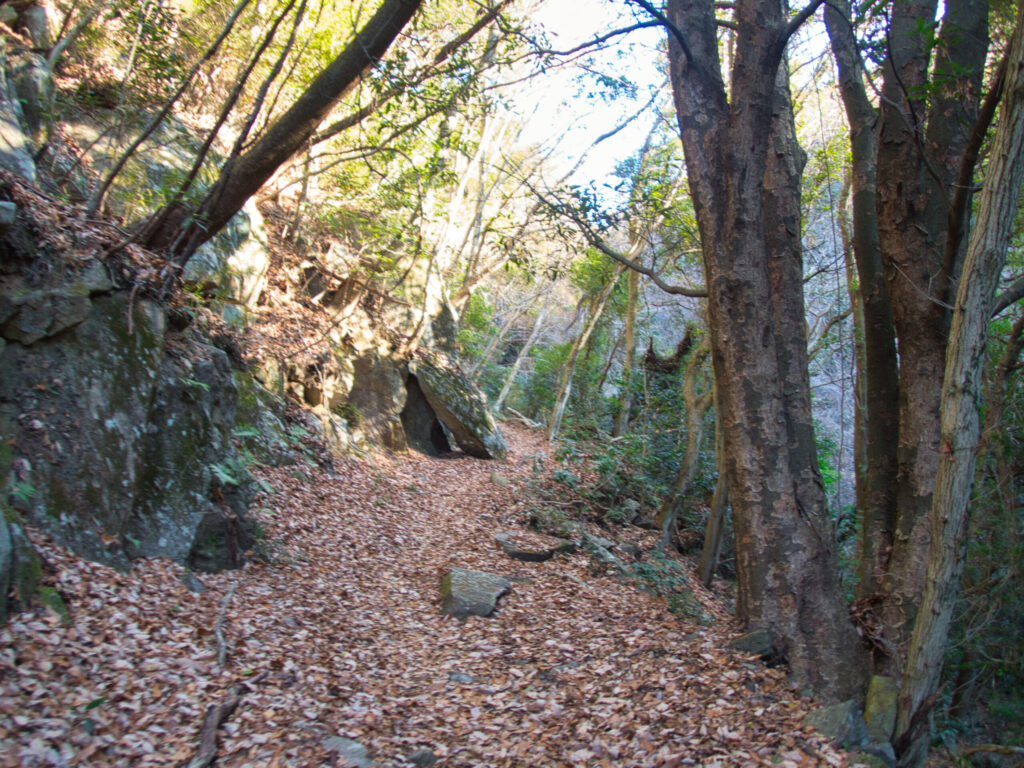
Kaba-san has long been known as a source of high-quality granite, and quarrying operations continue on its slopes to this day.
Beyond the fifth station, the terrain grew rockier. Nothing technically demanding, but sections requiring care. I directed each participant’s foot placements, watching weight shifts, reading timing. Those unfamiliar with rocky ground began, gradually, to find their rhythm.
There was one short section — just a few meters — where the footing was slippery. I guided the group through it with added caution. On the whole, however, conditions were favorable: calm winter sunshine, pleasantly warm, a fine day for the hills.
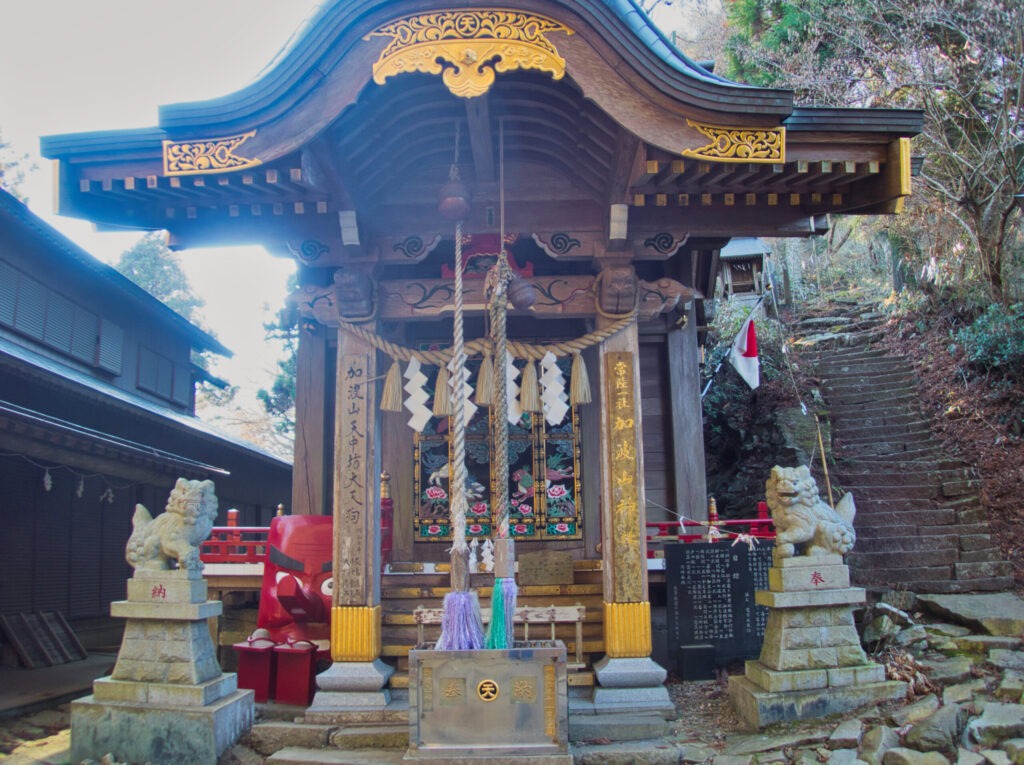
Just after ten in the morning, we arrived at Kaba-san Misakuji Jinja Oyamiya Haiden (Oyamiya Worship Hall). Tengu motifs adorned the shrine structures throughout — a living emblem of the mountain’s other name. The guests paused in quiet wonder before the tengu shrine, a sight none of them had encountered before. The air was heavy with a sense of layered history.
From Oyamiya Haiden onward, the route to the summit was a continuous procession of boulders and small shrines. Tiny halls of worship built among the rocks attested to the depth of devotion this mountain has inspired. Narrow staircases wound through gaps in the stone — an ascent that was itself an act of pilgrimage.
Along the way, a stone monument to the Kaba-san Incident stood in quiet solitude. Those young men of Meiji had climbed this same steep path seeking freedom, aiming for the summit. The monument marking their passage bore the characters “Jiyū no Sakigake” — Vanguard of Liberty. Several guests stopped and stood before it in silence.
We passed Tabako Jinja (Tobacco Shrine), a remnant of the days when tobacco cultivation flourished in this region. Prayers for quitting smoking are apparently offered here — a curious detail that spoke of the changing times.
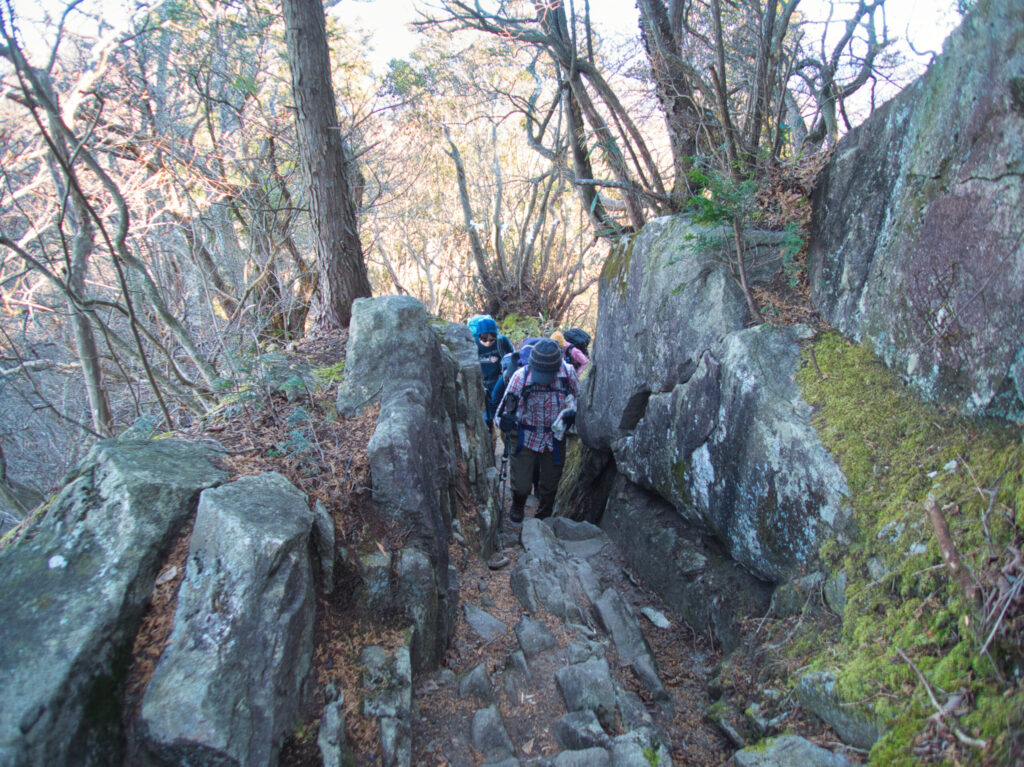
Closer to the summit, the rock steepened. Massive granite boulders layered upon one another, and we threaded our way upward between them. I confirmed holds carefully, moved deliberately, watched each participant. A nagging ache in my shoulder — some tendinitis I’d been carrying — made itself known with every arm placement, but it posed no obstacle to keeping the group safe.
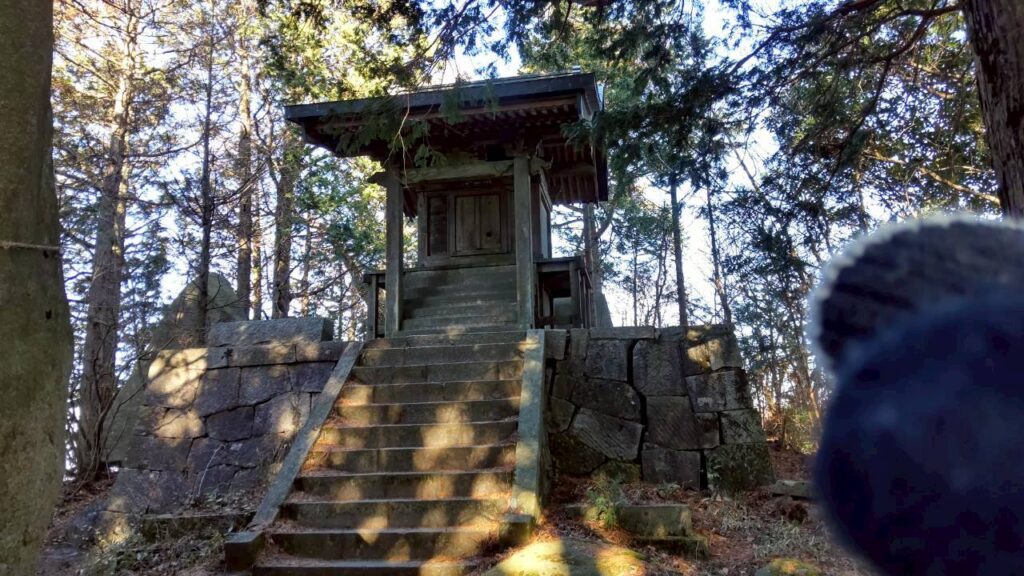
Just before eleven, we stood at the 709-meter summit. Kaba-san Jinja Hongu (Main Shrine) sat at the top, its gaze sweeping all directions. The group shared a quiet moment of accomplishment together. For those standing here for the first time, relief and fulfillment were written plainly on their faces.
The summit was wrapped in silence. No other hikers. The mountain was ours alone — an uncommon luxury. In the crisp winter air, the twin peaks of Mt. Tsukuba-san were visible in the distance. The wind had settled; the sun was kind.
We rested a while, each person spending the time as they chose. Some pressed their palms together before the main shrine. Others simply stood and looked out. I unscrewed the cap of my thermos with cold fingers, and the warmth of the tea spread through me. There is nothing quite like warmth in winter air. Sharing these quiet moments with guests — that is its own reward.
When the time came to descend, we took a different route: past Maruyama and on toward Ipponsugi-toge (Ipponsugi Pass).
Just beyond the summit of Kaba-san stands the Hatatate-ishi — the Flag-Raising Stone. In the seventeenth year of the Meiji era, Tomiyasu Masayasu and fifteen others arrived here carrying explosives, planted a banner reading “Jiyū no Sakigake” into this very rock, and made their stand. The stone remains today, unchanged.
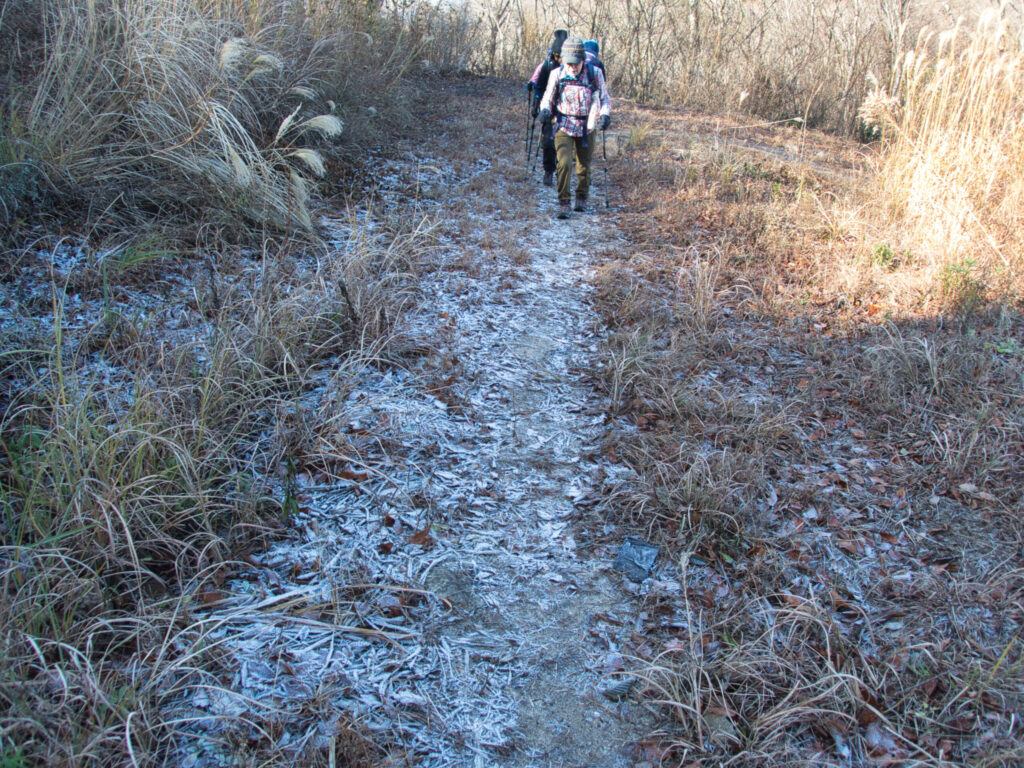
On the path toward Maruyama, there was a short frost-covered section. Looking down, the frost pillars caught the morning light and glinted silver, each one crunching dry and clean beneath the boot — a small, precise announcement that winter had arrived.
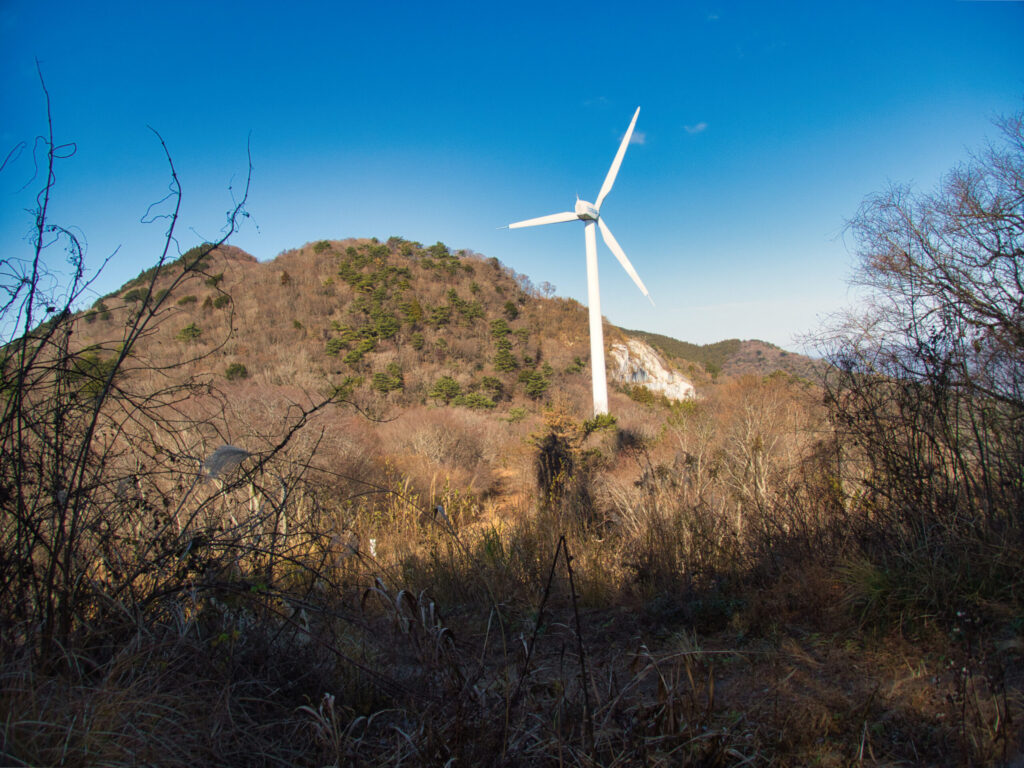
Maruyama offered no summit marker, no clear high point. But white wind turbines stood along the ridgeline, and the open face of a quarry was visible in the distance — faith and industry sharing the same mountain, a complicated history made visible in a single glance.
The descent demanded a different kind of attention than the ascent. Shorter steps, slower pace, to protect the knees. The descent trail, however, proved rougher than expected. Passable only on foot, it gradually gave way to a stream drainage.
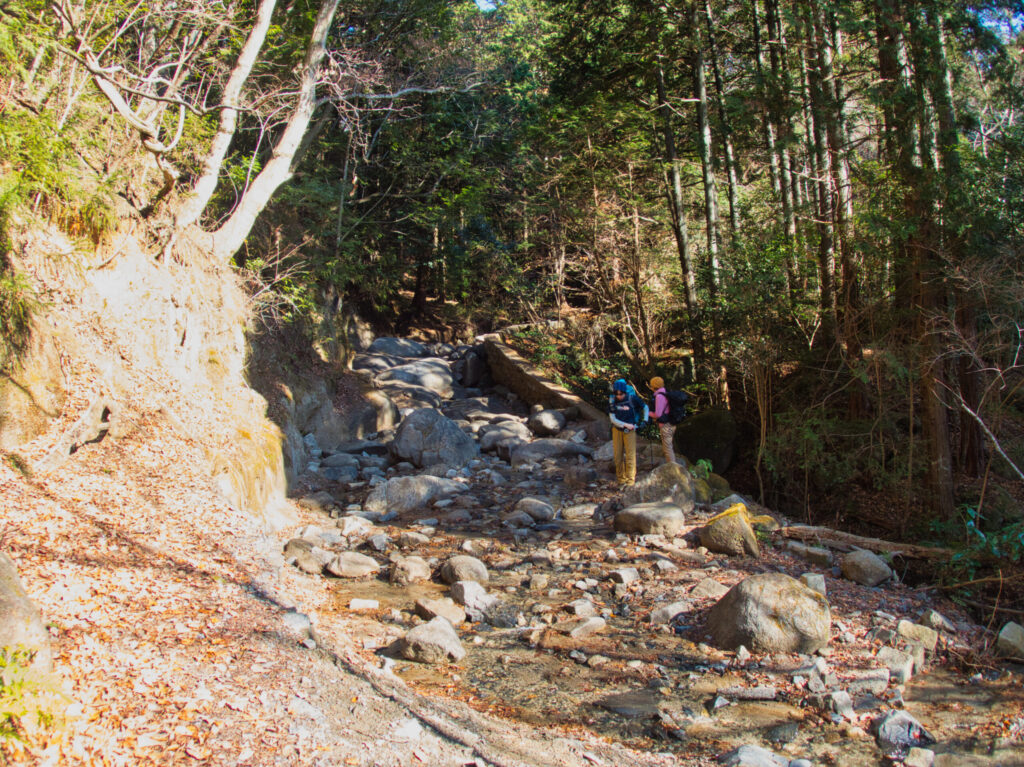
We were forced to ford the stream several times. Stepping stone by stone, finding balance, crossing to the far bank. I identified stable crossing points for each participant and gave clear direction. The rougher the terrain, the more deliberate the safety management must be.
From Ipponsugi-toge back to the third-station car park, a gentle descent continued. I encouraged brief rest stops as fatigue began to show. Pacing is always an element a guide must attend to.
The trail, maintained as part of the Kanto Fureai no Michi (Kanto Nature Trail), was well-trodden. We passed through winter-bare forest, losing elevation steadily. Conversation flowed freely among the group — a natural time to share memories of the day’s walk.
Just before one in the afternoon, we returned safely to the third-station car park. A walk of four and three-quarter hours. Relief settled over me as every participant came off the mountain without injury. Tired faces, but fulfilled ones.
We returned to Kaba-san Jinja Makabe Haiden (Makabe Worship Hall) to offer thanks for our safe return and complete the formal close of the day’s ascent. The mountain of the tengu sent us off in silence.
Afterward, we paused briefly at Kaba-san Ichiba (Kaba-san Market) before making our way to Michi-no-Eki Kasama (Kasama Road Station). Kasama City is one of Ibaraki Prefecture’s most celebrated chestnut-producing areas — Ibaraki itself ranking among Japan’s top chestnut producers. There, we tried the famous ultra-fine Mont Blanc.
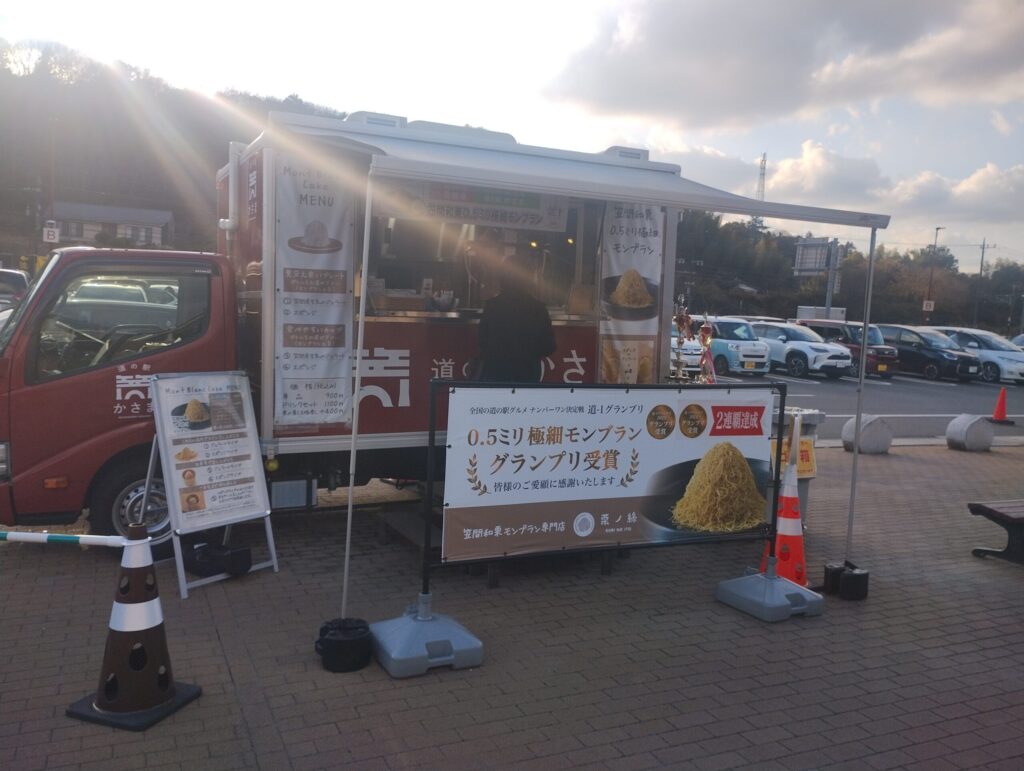
The Kasama Waguri 0.5mm Gokusen Mont Blanc (ultra-fine chestnut cream cake), served from the Kuri no Ito kitchen truck, took first place at the Michi-1 Grand Prix in both 2023 and 2024. Prepared to order and piped directly in front of you, the chestnut cream emerges in threads just half a millimeter wide — exactly as the name promises, as fine as silk.
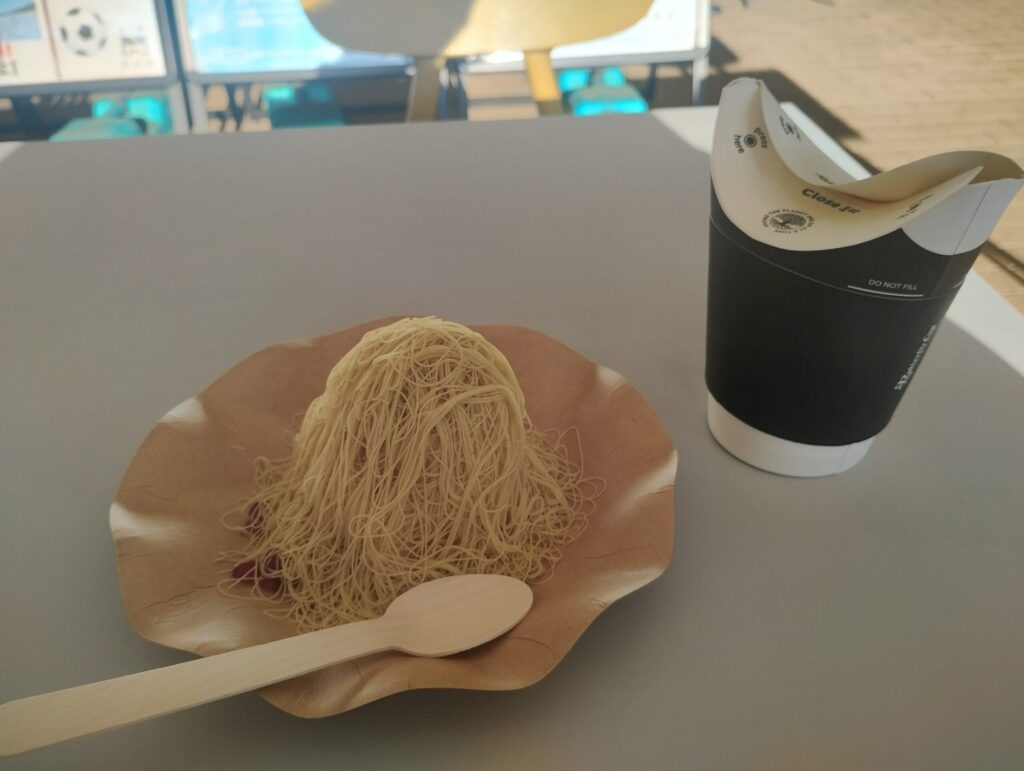
The base comes as either sponge or gelato; I chose the cream-and-sponge combination. With coffee, 1,100 yen. At the first bite, the texture dissolved softly in the mouth. The flavor of Kasama waguri — locally grown Japanese chestnut — spread quietly, restrained in its sweetness. The ultra-fine cream, airy with the texture of the extruding process, still carried the full depth of the chestnut’s character. Something sweet after a day on the mountain is always welcome. It settled gently into tired limbs.
Winter on Kaba-san is a layered world — faith, nature, and history woven together. Walking these sacred grounds alongside guests, in a place where tengu legend still breathes, was a privilege I felt as a guide. Watching first-time visitors genuinely moved by the mountain’s depth and the weight of its history reminded me, once again, of what this place holds.
It was a quiet walk. No other hikers all day. The mountain rested in winter stillness. But perhaps that stillness is Kaba-san’s truest nature. A mountain where 737 deities are said to dwell may simply prefer silence over crowds.
On the drive back to Fukushima, I watched the Tsukuba Renzan recede in the window. The profile of Kaba-san, lit by the winter afternoon sun, was calm. The mountain of the tengu waits quietly — for the next traveler to come.
【LOG SUMMARY】